
What would you do if you inherited a magnificent pleasure garden, complete with exotic birds, romantic grottoes, and a beautiful lake?
Fortunately, the descendants of a wealthy 19th-century Spanish marquis had a more generous idea.
During a recent visit to Cambrils, on Spain’s Costa Daurada, I discovered Parc Samà, a magnificent historic garden that once served as a private summer retreat for one of Catalonia’s prominent families.
Today, visitors can stroll through this extraordinary property, enjoying much of the same landscape that delighted its original owners more than 140 years ago.
A Marquis’s Dream
The story begins in 1881, when Salvador Samà i Torrents, Marquis of Marianao, commissioned a summer retreat near Cambrils.
The family gained their wealth in Cuba. When they returned to Spain the marquis wanted to recreate the tropical atmosphere of the Caribbean within Catalonia.
He enlisted the celebrated landscape architect Josep Fontserè i Mestres, whose other projects included Barcelona’s Parc de la Ciutadella.
The result was a 14-hectare estate combining romantic European garden design with exotic plants, ornamental architecture, and an extraordinary collection of animals.
Unlike the strictly symmetrical French gardens of earlier centuries, romantic gardens were intended to look more natural, with winding paths, hidden surprises, and picturesque views.
Of course, creating something that looks effortlessly natural requires considerable planning.
Peacocks and Parrots
Parc Samà is home to several species of ornamental birds, including peacocks, pheasants, parrots, and other colorful inhabitants.
But in the marquis’s day, the animal collection was considerably more extravagant.
Historical records describe monkeys, crocodiles, wolves, llamas, a panther, and even a bear.
The old monkey house remains part of the garden’s history, although the park’s present-day animal collections operate with a different emphasis, including conservation and animal welfare.
The Romantic Lake
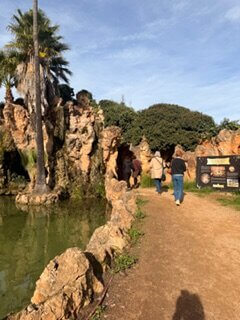
The highlight of my walk was the beautiful artificial lake.
The landscape includes rocky islands, bridges, grottoes, and carefully arranged views designed to create an atmosphere of romantic discovery.
The water appeared remarkably clear during my visit, allowing visitors to see beneath the surface.
I was especially taken with a small grotto beside the water.
There is something irresistible about these miniature caves, especially when they’re constructed to resemble natural rock formations.
A small opening frames the water beyond, creating the impression of a secret hiding place.
The lake’s central island is crowned by an artificial rocky hill, complete with a grotto and a viewpoint. The design draws on the tradition of English landscape gardens, where artificial ruins, caves, and lakes were fashionable features.
These were places designed not simply for walking, but for contemplation, conversation, and pleasure.
I could easily imagine the marquis’s family entertaining guests here during long summer afternoons.
A Garden with a Past
Yet the history of Parc Samà wasn’t always peaceful.
During the Spanish Civil War, beginning in 1936, the property was confiscated and converted into a military training center.
At one point, approximately 2,500 soldiers were housed in temporary barracks and tents throughout the grounds.
In 1938, the estate also served as a field hospital for wounded soldiers.
It’s difficult to reconcile that history with the peaceful landscape visitors encounter today.
Following the war, the property underwent another transformation.
Land that had once been devoted to pleasure and recreation became agricultural, with vineyards, olive trees, and hazelnut groves. Wine was also produced on the estate.
Eventually, the gardens regained their recreational purpose.
One particularly charming historical detail concerns Salvador Samà i Coll, the founder’s grandson.
He was the first member of the family to welcome public visitors into the garden. According to the park’s history, he enjoyed conversing with tourists and sometimes invited them to join him for refreshments on the veranda.
That seems a rather gracious way to share a family inheritance.
Your Own Private Garden
During your visit you will find walking paths, shaded areas, architectural details, and enough botanical diversity to make the experience interesting even without the historical background.
An excellent way to spend a few delightful hours.
Note: I was a guest of the park in association with my visit to the region as the IFoodTC Conference in Cambrils, Spain.
Visitor Information:
Parc Samà is located approximately five kilometers from Cambrils, between Cambrils and Montbrió del Camp, in Catalonia, Spain. Opening hours vary seasonally. For current admission prices and visitor information, visit parcsama.es.


