
Vinyes del Terrer is a small family winery near Tarragona, Spain.
As soon as you enter the gates, you see signs that this is not one of the billionaire wineries found in Napa, Bordeaux and other regions.
Diana, who handles tourism at the winery, met us at the door. As she greeted our group, her enthusiasm for the winery was apparent.
As Diana walked us around the vineyards, she shared the winery’s history.
A Family Dream
The winery’s history stretches back more than a century, when the Morell family cultivated a variety of crops, including almonds, hazelnuts, olives and grapes.
The modern wine venture began in 1989, when Joan Maria Morell Torrell planted Garnacha and Cabernet Sauvignon on ancestral farmland.
The family had originally moved onto the property to build a larger home. Today, the owner’s mother still lives there.
For years, the family concentrated on growing grapes for other producers. But when winemakers noticed something distinctive about their grapes, the family decided to produce its own wines.
In 2003, they began making wines under their own label, initially using rented winemaking facilities.
Their own winery followed in 2010.
Today, the estate encompasses approximately seven hectares of vineyards near Vila-seca, just over two kilometers from the Mediterranean Sea.
Unlike the imposing wine estates I’ve visited, Vinyes del Terrer retains the character of a family agricultural property.
Ancient Seashells
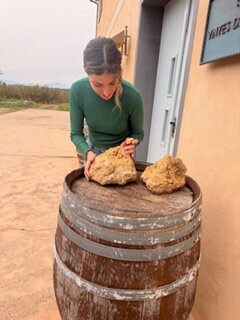
As we walked, Diana proudly introduced us to an unusual geological feature called lumaquela. This is a sedimentary rock containing fossilized marine shells.
Millions of years ago, she explained, the area was covered by the sea. Today, remnants of that ancient marine environment are embedded in the vineyard soils.
The family discovered the fossils when they removed hazelnut trees and prepared the land for planting vineyards.
The vineyards also benefit from their Mediterranean location, where sea breezes moderate the warm summer temperatures.
Diana believes these growing conditions contribute to the distinctive saline character of the wines.
Wine Tasting
After a tour of the vat room, our group climbed to a second-floor tasting room with large windows overlooking the vineyards.
There, Diana guided us through ten wines, including whites, rosés and reds.
My favorite was one of the estate’s more modestly priced wines called Blanc del Terrer. Produced from the indigenous Macabeo grape, the 2023 vintage displayed a particularly memorable combination of saline characteristics and delicate honey notes.
Other wines included Garnacha in its red and rosé forms, Cabernet Sauvignon blended with Garnacha, and a 100% Sauvignon Blanc with fresh acidity.
During the winery tour, Diana explained that the grapes are hand-selected in the vineyards, chilled after harvest to preserve freshness, and sorted again before processing.
The emphasis, she explained, is on fruit character and freshness.
Wine Under the Sun
Another memorable sight was a collection of large glass demijohns standing outdoors.
These vessels are used in producing the winery’s traditional rancio wine.
Rather than protecting the wine from oxygen and temperature changes, the winemaking process deliberately exposes it to the elements.
The estate’s Terrenal d’Aubert Rancio undergoes two years of oxidative aging in glass demijohns, followed by two years in old oak barrels.
The traditional Catalan technique is known as sol y serena, meaning exposure to sun and night air.
Diana explained that rancio is also part of Catalan cooking traditions, including dishes such as fricandó, a slow-cooked beef preparation with sauce.
It was a great visit to a typical family winery in the region, “flavored” with that special lumaquela element.
Note: I was a guest in association with my visit to the region as the IFoodTC Conference in Cambrils, Spain.