
Fongoli: Four Winemaking Generations in Montefalco
In the heart of Sagrantino country, surrounded by the gentle hills and knotty old olive trees of Montefalco, you’ll find a winery that seems to exist both in the past and in the present.
It’s not trying to recreate history. It simply never let go of it. That’s Fongoli. And stepping into the winery for the first time with a group of fellow journalists, I could tell immediately that something here felt distinctly personal.
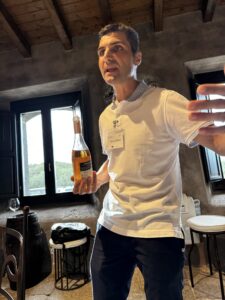
The Fongoli family has been making wine for over a century. Four generations deep, today’s steward is Angelo Fongoli, who runs the estate with his wife, Letizia, and — as I witnessed firsthand — even their teenage son sometimes steps in to help pour for guests.
Watching him politely assume hosting duties reminded me what it’s like to grow up inside a tradition bigger than yourself. Here in Umbria, it seems kids learn early that harvest time, guests, and service are part of family life.
Fongoli isn’t trying to impress anyone with flash or industrial sparkle. In fact, part of what makes it so memorable is what past generations chose not to change.
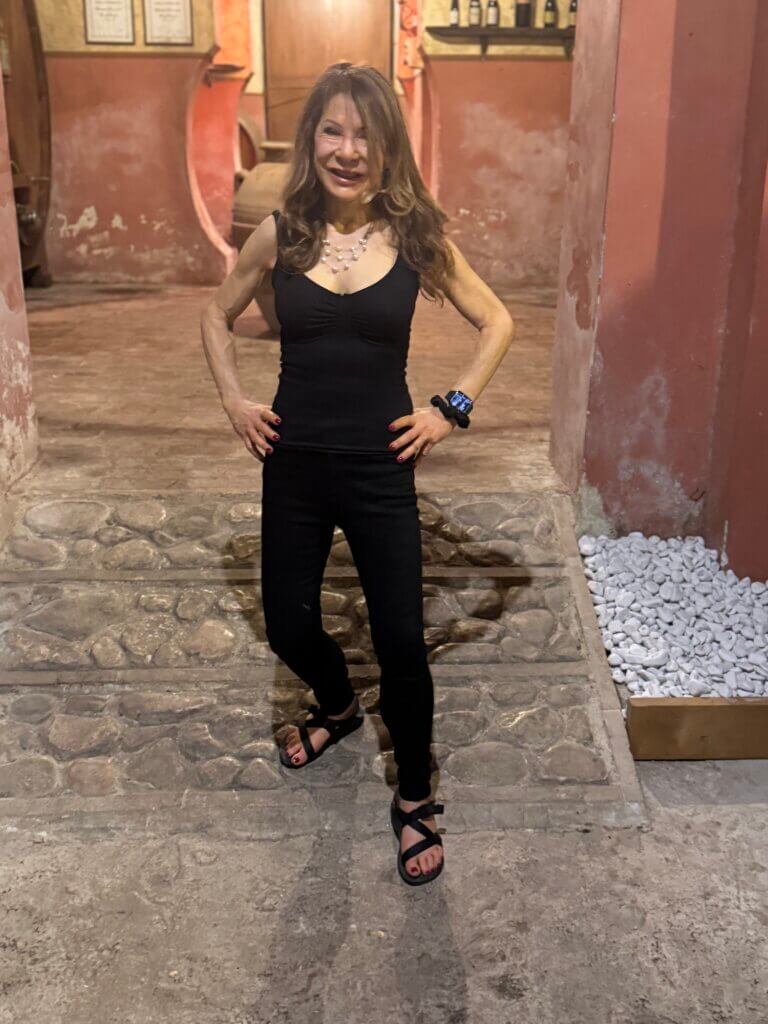
In the 1980s, when many winemakers across Italy were renovating their cellars to appear more modern — adding polished steel and sterile light — Angelo’s father resisted. He kept the aging cellar true to its early 20th-century character. |
The result is a beautifully atmospheric cantina, full of warm brick, old photos, worn tables, low light. It’s the kind of space that makes wine feel intimate again. And it’s a perfect setting for the way they pour wines here: slowly, family-style, with conversation.
But let’s be clear — this is not a museum piece. Fongoli is forward-looking when it counts. Since 2013, all 40 hectares of the farm have been certified organic, and Angelo has gone much further, fully embracing biodynamics across vineyard and cellar.
What was once a near-monoculture has been diversified again — vines, olive trees, woodlands, and even truffle ground share the land. In the vineyard, cover crops like legumes are planted to keep the soil alive and open. No chemical inputs, no shortcuts. The goal is simple: healthy fruit, grown respectfully.
In the cellar, the philosophy follows suit. Native yeasts are non-negotiable. No additives are used, not even sulfur. Some wines age in stainless steel (with or without temperature control), others in oak, and a few — notably Maceratum and Fracanton — are aged in amphora made in the nearby town of Deruta. Angelo and Letizia’s approach is focused but not doctrinaire. They’re not afraid of tradition, or of breaking it, when it serves the wine.
The estate itself is planted with the native grapes you’d expect in Montefalco: Trebbiano Spoletino, Grechetto, Sangiovese, Montepulciano, and of course, Sagrantino. Among the lineup, each wine is distinct, but shares one clear thread — no excess.
From the crisp, golden Trebbiano Spoletino Metodo Ancestrale, re-fermented in bottle using reserved must, to the earthy depth of their Serpullo Montefalco Rosso Riserva, the wines don’t chase high polish or modern flash. They’re textural. Alive. Sometimes surprisingly wild. But always a direct reflection of place.
These are not wines made by committee. At the tasting, I noticed how certain bottles reflected the mood of the people who made them. There is history here, yes, but also intention.
The Bicunsio Montefalco Rosso is a good example — a red that feels deeply tied to the land, with structure that doesn’t overwhelm, and a character that invites food, or just conversation. The amphora-aged Fracanton, made from 100% Sagrantino, is an homage to Angelo’s grandfather and great-grandfather. It’s powerful, gripping, a touch rustic in the most satisfying way — the kind of wine that doesn’t just linger on the palate, but in memory.
One of the unexpected pleasures of the visit was how relaxed everything felt. This wasn’t a lecture or product pitch. Angelo and Letizia moved through the tasting at their own rhythm, telling stories, pouring wines, and pausing to laugh with their son — or with us.
Their warmth, and the presence of family on every wall and in every room, makes you feel less like a guest, and more like part of whatever’s unfolding that day.
Over the years, many of Fongoli’s wines have earned recognition: DOC status in 1977, local and national awards in the ’80s and beyond, a loyal following of drinkers who prefer quiet substance to bold headlines. But Angelo doesn’t talk much about that. His focus is on what’s in the glass right now — and how to make sure it still reflects the truth of this place, without compromise.
If Montefalco is evolving — and it is — wineries like Fongoli show that change doesn’t always mean reinvention. Sometimes it just means going deeper. Slower. With more care.