
Montefalco Wine Masterclass
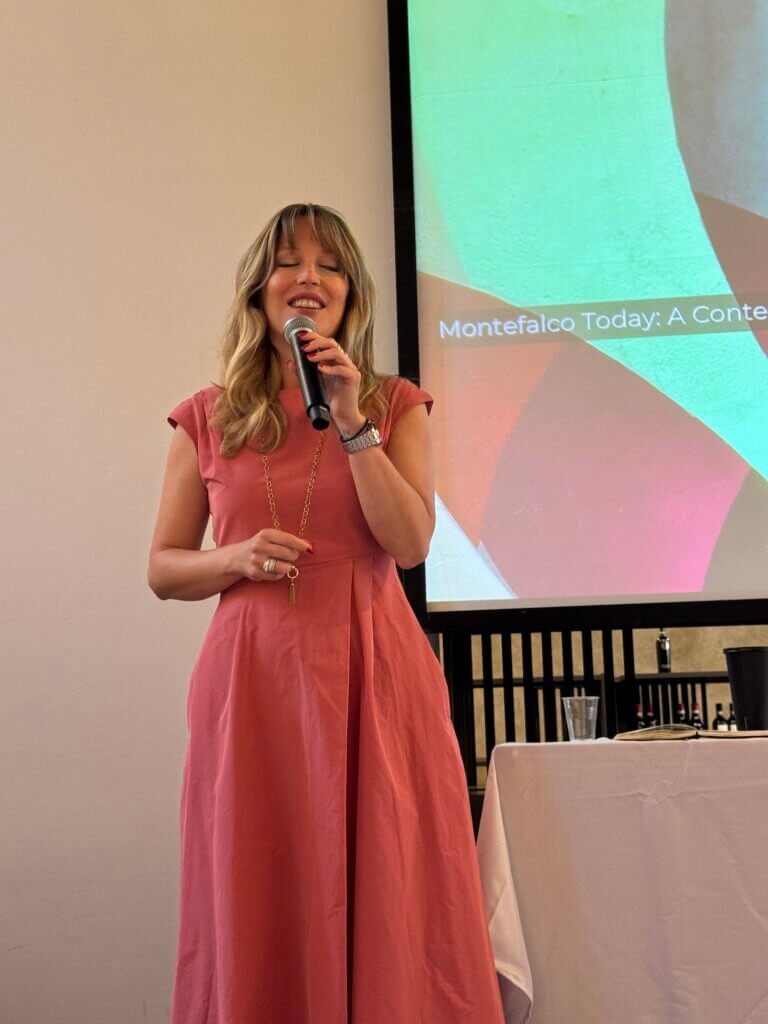
After several days of visiting wineries and tasting the native grapes of Montefalco, it was a pleasure to attend the Masterclass called “Contemporary Montefalco” led by Cristina Mercuri DipWSET, held in the Chiostro S. Agostino in Montefalco
The wines in our glasses—Trebbiano Spoletino, Sagrantino, Montefalco Rosso—spoke of place, yes, but also of change. And Cristina’s approach was anything but academic. Rather than set in stone what we were supposed to taste, she laid out the framework—soils, altitudes, exposures—then challenged us to draw our own conclusions.
Montefalco, as she explained, is not one flat zone but a patchwork of microclimates within the DOC and DOCG. The overall climate is moderately continental—warm summers, dry and windy conditions—but, within that, significant variation.
Each of the five communes that make up Montefalco has its own geological rhythm. Some are rocky, some clay-heavy. Chalky soils in the east produce whites with floral lift and higher acidity. Other areas yield bold reds with darker textures and more tannic grip. Geography isn’t background here—it’s choreography.
Can Trebbiano Spoletino grown ten kilometers apart taste completely different? We found out. Cristina poured three white wines blind and told us one was not Trebbiano Spoletino at all. It was a sort of palate test—but more than that, it was a lesson in attentiveness.
Tasting quietly, thoughtfully, informed by her prior explanation, we worked through them. The “impostor” turned out to be Trebbiano d’Abruzzo—bright, fresh, linear—clearly a bit different. That alone explained much of what makes Trebbiano Spoletino so valuable: its ability to express structure, acidity, and depth without losing aromatic nuance. It’s not just a backdrop grape; here, it’s a lead voice.
Later in the tasting came a similar move—a blind red flight featuring several Montefalco Sagrantinos and one ‘secret Syrah’ a wine from the Northern Rhône.
Once again, we were asked to deduce the outlier. What followed was a lively discussion about texture, tannins, mouthfeel. While varietal DNA helps define a grape, winemaking and terroir leave fingerprints too. And to be honest, the Syrah was delicious—elegant, polished—but it didn’t express the Montefalco edge, that inner energy I now associate with Sagrantino.
Sagrantino, native to this region and grown on just 380 hectares, is one of Italy’s deepest reds, known for high tannins and late ripening. In the past, harsh extraction or rushed winemaking sometimes masked its beauty.
Yet Montefalco today is not trying to outpower the world—it’s pivoting. Many producers, including some I visited during the week, are turning to a fresher, finer-grained style. Earlier picks, attentive maceration, longer aging. The wines I tasted confirmed it. Black currant, violet, licorice—yes. But now you find more restraint, more lift, and, in some cases, an almost suede-like tannin texture. Silky, even. Especially in 2017 and 2020, vintages with marked ripeness but enough acidity to hold things in place.
Cristina touched on that too—how vintage and vineyard interact. 2016 and 2019, for example, brought cooler nighttime temperatures, giving higher acidity and aromatics. 2015 still shows the old school: bold, plush, a bit rustic in the best way. All are valid expressions. Montefalco doesn’t need to shed its character to be contemporary—it just needs to embrace its complexity.
And it does.
What made this seminar so valuable is that all of us in the room had just spent days on the ground visiting producers. So these weren’t unfamiliar wines. They were wines we’d tasted at the source, spoken about with winemakers, sometimes even tasted from cask. Having them again here, in this setting, helped tie the thread together. And hearing Cristina narrate the geography and grape logic behind them helped us connect taste to place.
As a wine writer, I’ve seen my share of tasting seminars. Some educate, others feel safe and polished. This one felt alive. Using the “planted surprise” technique—slipping in a non-local wine to keep people sharp—felt just right. It spoke to confidence in the region. “These wines can stand alone,” it said, “but they also stand apart.”
In the end, my strongest takeaways weren’t just about which wines were “best” or most age-worthy. It was the people I met—at Perticaia, Colle Ciocco, Fongoli, Lungarotti—each expressing the identity of Montefalco in their own quiet way. The tasting room at Perticaia, where the team spoke about picking everything by hand. The decades-old Fongoli cellar, still glowing with family life. Matteo from Colle Ciocco, talking about coming home, not leaving.
Montefalco may not be the biggest region. But it’s one of the few that feels this complete—variety without chaos, tradition without resistance to change. The week was well-planned: a mix of small group visits, larger events, and open discussions. But this seminar brought it all home. A portrait of a region in motion.