Consorzio Vino Nobile di Montepulciano Tasting
If you have ever stood in a wine shop staring at a wall of Tuscan bottles and wondered where to begin, imagine stepping into a week-long wine event where Tuscany lays out its identity in full view.
Anteprime Toscane is an annual preview of new vintages from nearly every major Tuscan denomination. It is a rare opportunity to taste widely, compare styles, question producers, and understand why these wines are among the most sought-after in the world.
From accessible bottles that elevate a simple dinner to cellar-worthy standouts, each bears the initials DOC or DOCG on the label. This is Italy’s straightforward assurance that strict rules govern origin, grape varieties, and aging.
The Vino Nobile di Montepulciano Tasting
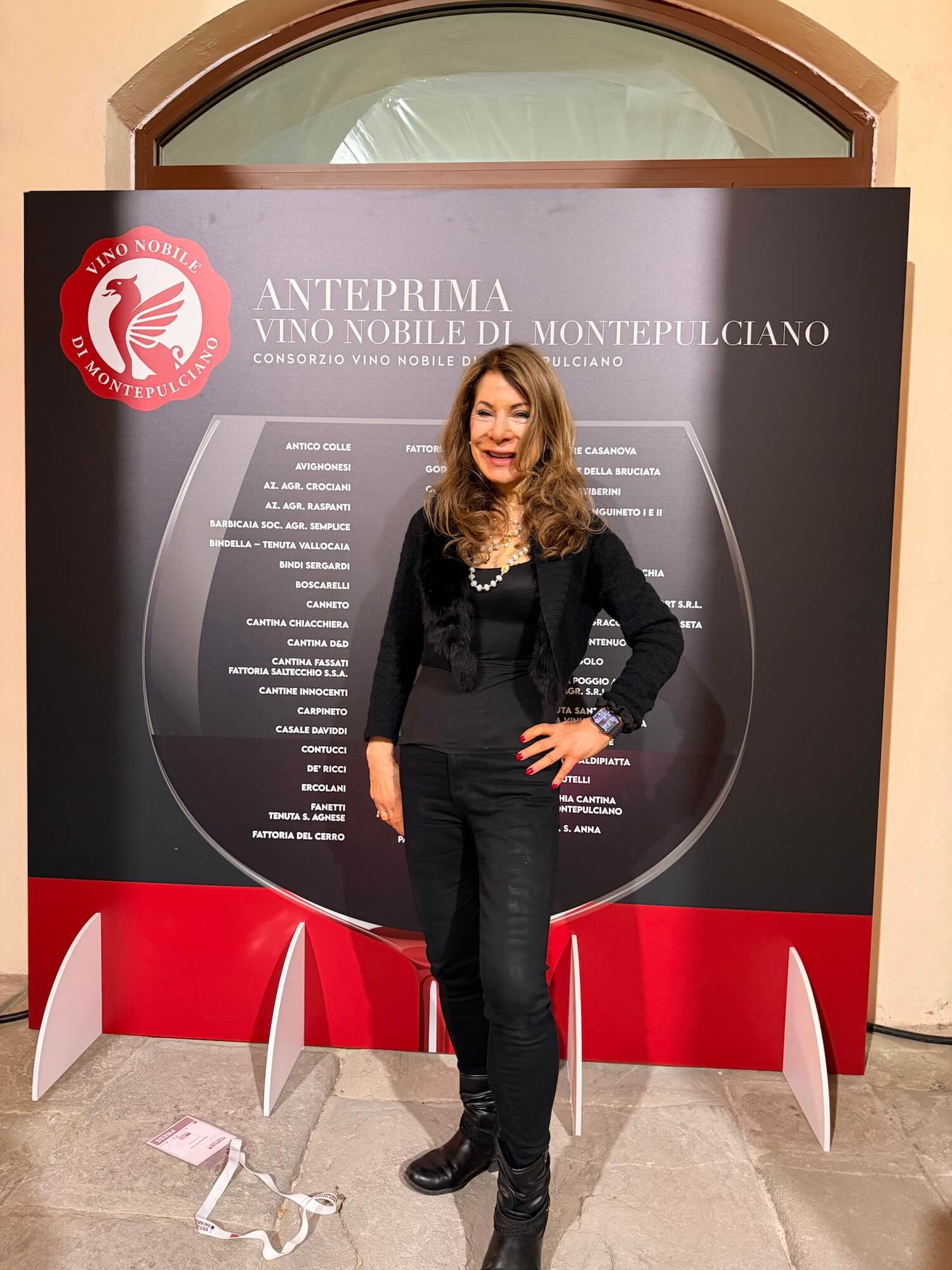
Today’s tasting is an official Anteprime Toscane event hosted by the Consorzio del Vino Nobile di Montepulciano. During this week, journalists travel across Tuscany to experience each region in depth. The purpose is to understand the vintage, speak with producers, and evaluate how the wines express the year.
I arrive at my station and see the customary six glasses and a tasting list waiting for me. You may wonder why six glasses?
Because comparing wine side by side changes everything.
Instead of finishing one pour before moving to the next, you can taste across vintages and classifications at the same time. You notice how tannins tighten or soften. You see color differences — ruby versus garnet. You discover how structure builds from one glass to another.
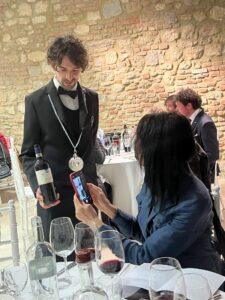
The wines are poured blind. No producer names. Only numbers. A printed list replaces labels. You choose by vintage and classification, and beautifully dressed sommeliers deliver the pour without commentary. Blind tasting removes reputation from the equation. Prestige cannot influence your palate. Only aroma, texture, and balance matter.
It’s like a conversation between you and the glass.
Popularity of Tuscan Wines
Tuscan wines hold global popularity for a reason. They offer diversity. Hills, soils, elevations, and microclimates vary dramatically from one town to another.
That diversity appears in price as well. You can find an honest, beautifully made Tuscan DOC bottle for a modest price — or invest in a structured DOCG wine designed to age for decades.
DOC (Denominazione di Origine Controllata) and DOCG (Denominazione di Origine Controllata e Garantita) are not marketing slogans. They are legal frameworks.
They dictate where grapes must be grown, which varieties are permitted, minimum aging periods, and even yield limits in the vineyard. DOCG, the highest tier, includes additional guarantees and tasting panels before release.
In short: these wines follow rules.
Wine Dinner with Producers
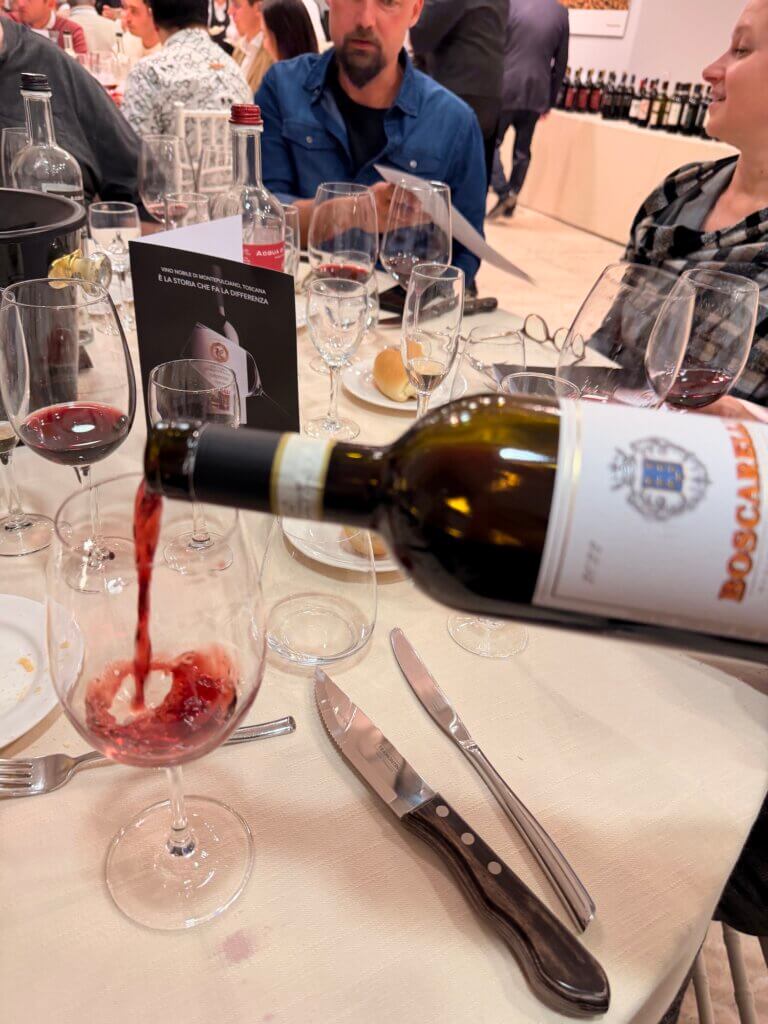
The contrast begins the evening prior. Producers pour their wines directly. Bottles are visible. Conversations flow freely. You might select a 2020 Gran Selezione from a favorite estate and immediately confirm whether your impression aligns with the producer’s intention. Soil composition? Aging vessel? Elevation? The winemaker answers in real time.
It is recognition tasting. Memory connects wine to personality.
Then comes today — silent, anonymous, stripped of identity.
What Exactly Is Vino Nobile di Montepulciano?
Here is where confusion often begins.
Vino Nobile di Montepulciano does not refer to the Montepulciano grape. It refers to the town of Montepulciano in southern Tuscany.
The primary grape is Sangiovese, locally called Prugnolo Gentile. Regulations require a minimum of 70% Sangiovese in the blend. The remaining percentage may include approved local varieties, but always within strict limits set by the Consorzio.
The word “Nobile” dates back centuries, when noble families of Montepulciano favored the wine. It was known as the wine of nobilityhence the name.
So when you see “Vino Nobile,” you are looking at a Sangiovese-based wine from a specific geographic zone, governed by DOCG regulations.
Gran Selezione
The tasting list includes vintages from 2020 and 2021 labeled Gran Selezione. These wines are still youthful, but they carry the beginning of maturity. What might be called a patina of age.
Gran Selezione represents the highest tier within the denomination. Grapes must come entirely from the estate’s own vineyards. Aging requirements exceed the base level. Selection standards are stricter.
In the glass, the structure shows immediately. Tannins frame the fruit. Acidity provides lift. Aromas hint at dark cherry, dried herbs, sometimes tobacco or leather. These wines are built with intention.
Tasting them first allows you to evaluate the backbone of the vintage before moving to younger expressions.
What Does “Riserva” Mean?
Riserva indicates extended aging — at least three years total before release, including time in wood and bottle. Time transforms wine. Primary fruit softens into layered complexity. Spice, earth, and secondary notes emerge.
If the Gran Selezione shows architectural strength, the Riserva shows evolution. Edges smooth. Structure integrates.
Understanding “Riserva” on a label simply means this: more time, more development, more depth.
The Current Release: 2023
The youngest wine in the room is the current release, 2023.
Youth brings vibrancy. Fresh red fruit. Lively acidity. Tannins that still grip firmly. This is often the most approachable style for near-term drinking.
Tasting it last highlights the arc of aging. You move backward in time, from polish to raw energy. And suddenly aging rules make sensory sense.
Terroir Without the Textbook
Why do these wines differ from one another if they share the same grape?
Terroir.
Clay-rich soils produce power and structure. Sandier soils offer finesse. Higher elevations preserve acidity and freshness. Lower slopes may yield ripeness and warmth. Even exposure to sunlight matters.
Weather shifts from year-to-year influence balance between fruit concentration and acidity. A warmer vintage might show plush texture. A cooler year might emphasize brightness and tension.
You taste geography. You taste climate. You taste time.
How to Use This Knowledge at Home
You do not need six glasses to enjoy Tuscan wine at home. But you can use the clues found on the label:
- DOC or DOCG: regulated origin and quality.
- Vino Nobile di Montepulciano: Sangiovese based wine from Montepulciano.
- Riserva: extended aging.
- Gran Selezione: estate-grown fruit and highest tier.
Pair these wines with roasted meats, aged cheeses, tomato-based pasta dishes, or even a simple grilled steak. The acidity in Sangiovese makes it remarkably food-friendly.
Most importantly, know that Tuscan wines span price ranges. Excellence is not limited to luxury tiers. The structure and balance that define the region appear at many levels.
Six Glasses, One Identity
Back in the tasting hall, the six glasses now hold varying shades of ruby and garnet. Numbers replace names. Without labels, reputation disappears. What remains is sensation — aroma, texture, finish.
That is the purpose of Anteprime Toscane. Not simply to announce a vintage, but to demonstrate why Tuscan wine holds its place on tables around the world.
The next time you see Vino Nobile di Montepulciano on a shelf, you will not wonder what it means. You will know that behind that name stand regulations, geography, and tradition. So perhaps six glasses in a quiet room in Montalcino, where Tuscany tells its story one pour at a time.
: