Benedetti & Grigi in Montefalco
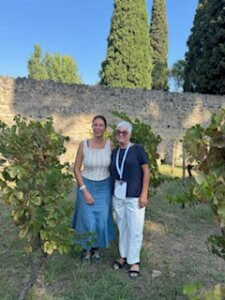
Every now and then on a press visit, one winery teaches you a little more about the region than you expected — sometimes not just through what’s in the glass, but through its people, its structure, and the choices it’s making year after year. For me, on my most recent trip to Montefalco, that winery was Benedetti & Grigi.
Located just a few minutes outside Montefalco’s historic center, Benedetti & Grigi may be a relatively young operation — their first vintage under their own name was only in 2014 — but they’ve moved quickly and intentionally. Today, they farm around 80 hectares of vines and bottle approximately 500,000 wines per year, producing for several tiers of the market. Some wines are aimed at discerning private clients and connoisseurs; others are created for high-end supermarkets, with distinctive, eye-catching labels. But at no point does quality take a back seat to scale.
When we visited, we were greeted with a comprehensive guided tour of the facility, followed by a wide-ranging tasting — easily one of the most varied of the week. We tasted wines across multiple lines, including several reserve labels, white wines aged with skin contact, and Sagrantinos from different vintages. It was the kind of visit that gives you a broad but clear sense of a winery’s philosophy.
The story behind Benedetti & Grigi is just as compelling. The two founding families came from very different sides of agriculture: one with expertise in arable cereal crops and poultry, the other with deep family ties to the land around Montefalco. The cellar they built together started with what they believed was state-of-the-art technology — but as the climate shifted, so did their philosophy. Investments didn’t stop at construction. Over time, they updated both vineyard practices and winemaking equipment year after year, evolving toward a more tailored, vineyard-specific approach.
One key idea came from an agronomy professor: “Not even two square meters of ground are exactly alike.” That insight now underpins one of Benedetti & Grigi’s core methods — vinifying according to micro-parcel, even when those parcels are only steps apart. Their holdings span several sites, including the Castello di Limigiano, known for its clay-heavy soils that produce deep reds; Terre dell’Abate with its loam-rich ground ideal for layered white wines; and La Polzella, where vines thrive even in the stressful heat of the growing season thanks to deep, fresh soils.
In the cellar, white wines follow an especially careful path: hand-harvested, chilled overnight, gently destemmed, cryomacerated under nitrogen, and fermented at low temperatures in steel. Trebbiano Spoletino, one of Umbria’s calling-card grapes, sees both freshness and structure here. One Trebbiano we tasted — from the 2022 vintage — had an unmistakably golden hue, intense apricot aromas, and a textured mid-palate shaped by skin contact. While the deeply golden color technically disqualified it from the Spoleto DOC label, that hasn’t stopped the winery from pursuing this style. For them, the wine’s quality speaks louder than classifications.
Sagrantino — the big, bold grape of Montefalco — is handled with similar precision. Grapes are partially hand-harvested, fermented by variety, and allowed long macerations to balance flavor with tannin refinement. One standout detail: on some wines, malolactic fermentation happens during maceration, not after — a decision that impacts both softness and integration. Later, aging occurs in large oak barrels, concrete, or even amphora, depending on the wine’s trajectory.
During our vertical tasting, we sampled multiple vintages of Sagrantino. It was clear how each year shaped the wine in different ways. In 2018 — considered a difficult vintage by many — their Sagrantino showed surprising depth, the long skin contact having successfully rounded out the tougher edges of that cooler, inconsistent harvest. A few of the wines from 2016 and 2019, on the other hand, were marvels in balance: lifted aromas like rose and violet, smooth tannins, and generous length.
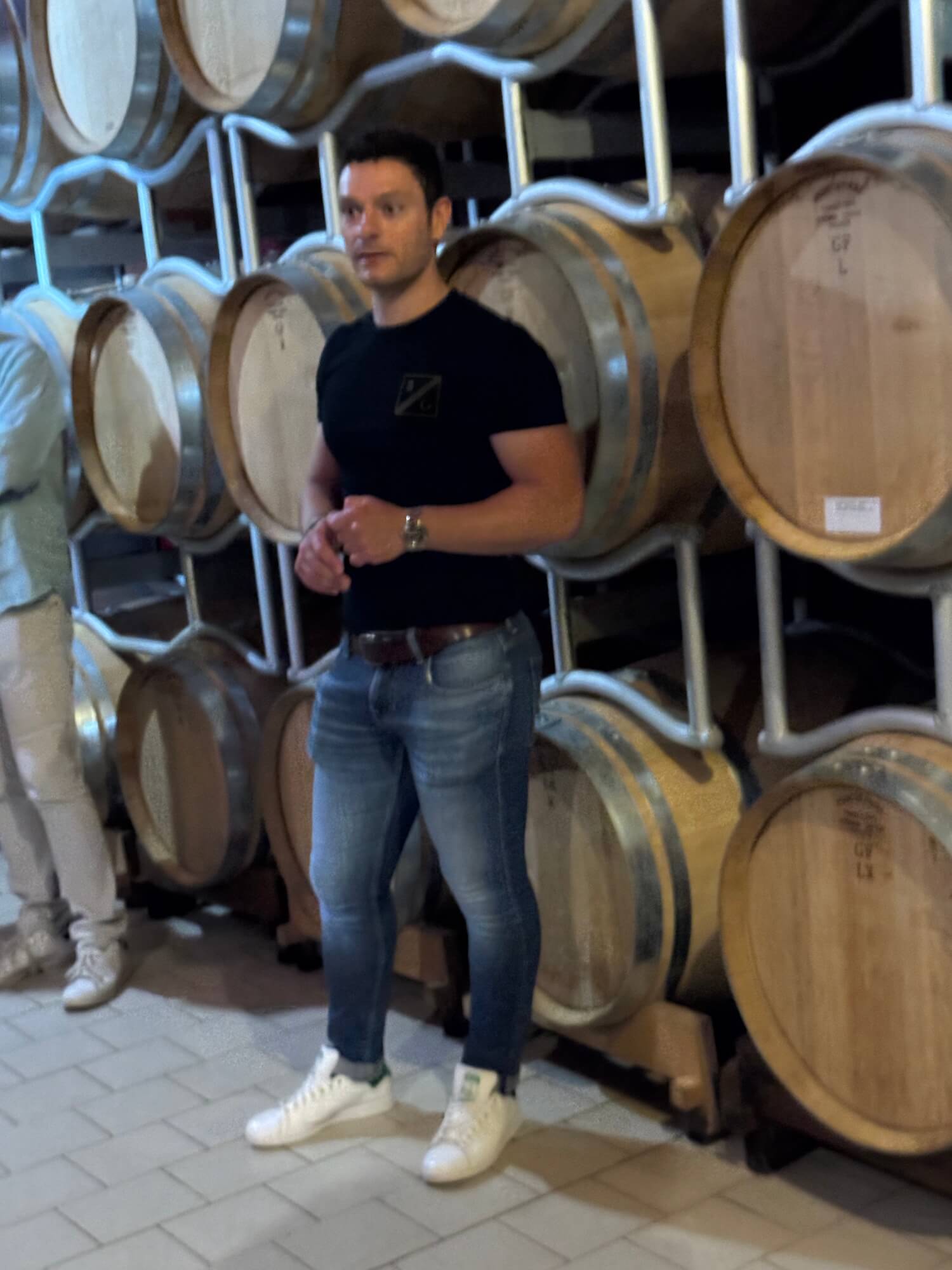
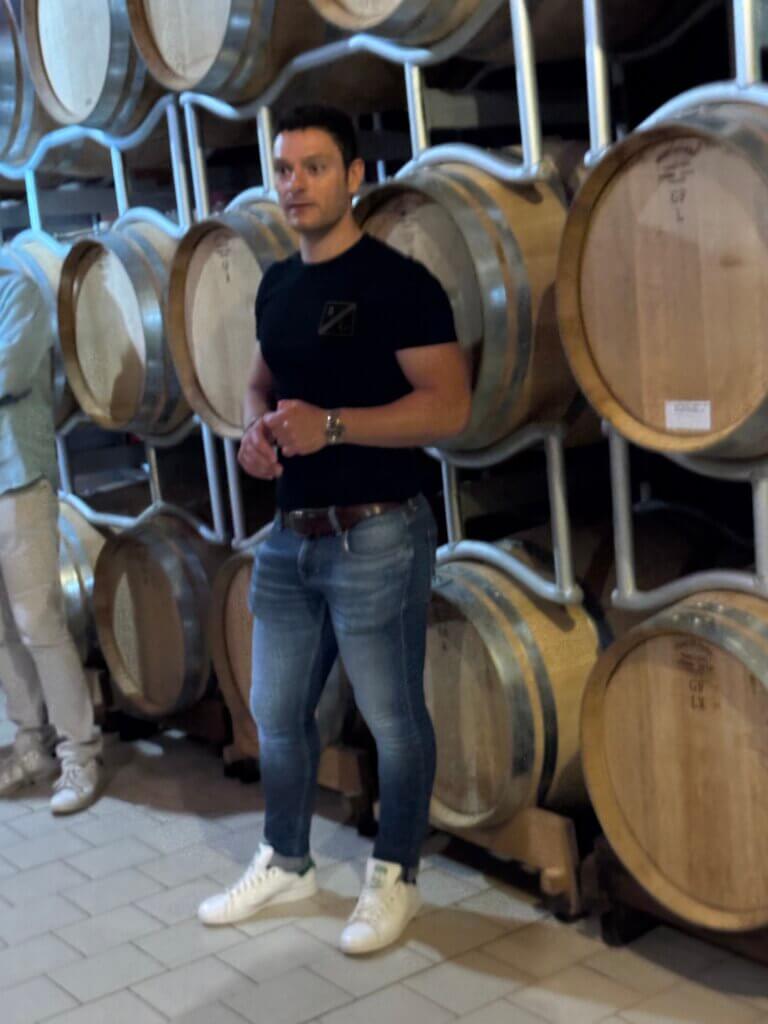
Matteo Benedetti, who walked us through part of the facility, made it clear that this is still a work in progress — and that’s part of what makes Benedetti & Grigi interesting. They are not trying to emulate a time-honored family tradition passed generation to generation. Instead, they are building one, drawing from agriculture, science, and a deepening sense of regional identity. Even the idea of keeping a second facility exclusively for long-term barrel-aging and bottle storage shows their foresight and commitment to flexibility.
There’s also a refreshing honesty to how Benedetti & Grigi moves in the world. They know that some wines are destined for a supermarket shelf — and they don’t treat them as throwaways. Instead, they create distinctive labels and distinct profiles that still reflect the same vineyards and technical care as their more prestigious bottlings.
Montefalco is full of small family wineries run by multiple generations — and I admire that. But it’s equally encouraging to see newer estates, like this one, taking the region seriously and shaping it from a different angle. Benedetti & Grigi may be young, but they’re already showing what happens when thoughtful innovation meets commitment to place.
Lorem ipsum dolor sit amet, consectetur adipiscing elit. Ut elit tellus, luctus nec ullamcorper mattis, pulvinar dapibus leo.