Rossillon White Wines
Roussillon has long been defined by its reds—powerful & sun-soaked. In the past they were often high in alcohol.
Today these wines are more balanced and still deeply rooted in the rugged landscape of southern France.
I adore them.
Yet after a recent visit, he region’s white wines may be its most underappreciated asset.
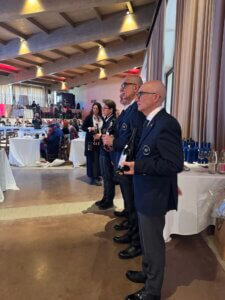
This realization came into focus over the course of the two last winery visits organized by the Association of Wine Educators (AWE) in partnership with regional bodies, under the guidance of Eric Aracil.
Our small group of roughly a dozen members, most holding advanced qualifications such as the WSET Diploma, approached the tastings with a shared technical foundation.
We knew the region’s high reputation and were keenly familiar with the techniques of the Roussillon’s classic wine production.
What many of us did not expect were the extreme high quality of the mineral-driven white wines.
The first visit, to Château de l’Ou, immediately set the tone. The estate itself sits in a wooded, almost secluded setting, its modern construction blending quietly into the surroundings.
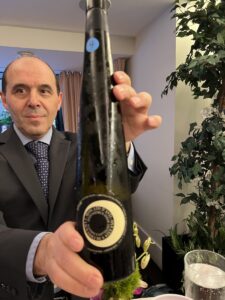
Yet before even entering the winery, one encounters a striking visual cue of tradition: large-format glass vessels—jeroboam-style containers—used for the oxidative aging of sweet wines. They were arranged near expensive looking outdoor vats dedicated to the same purpose.
These vessels, placed in full view, establish a dialogue between past and present before a word is spoken.
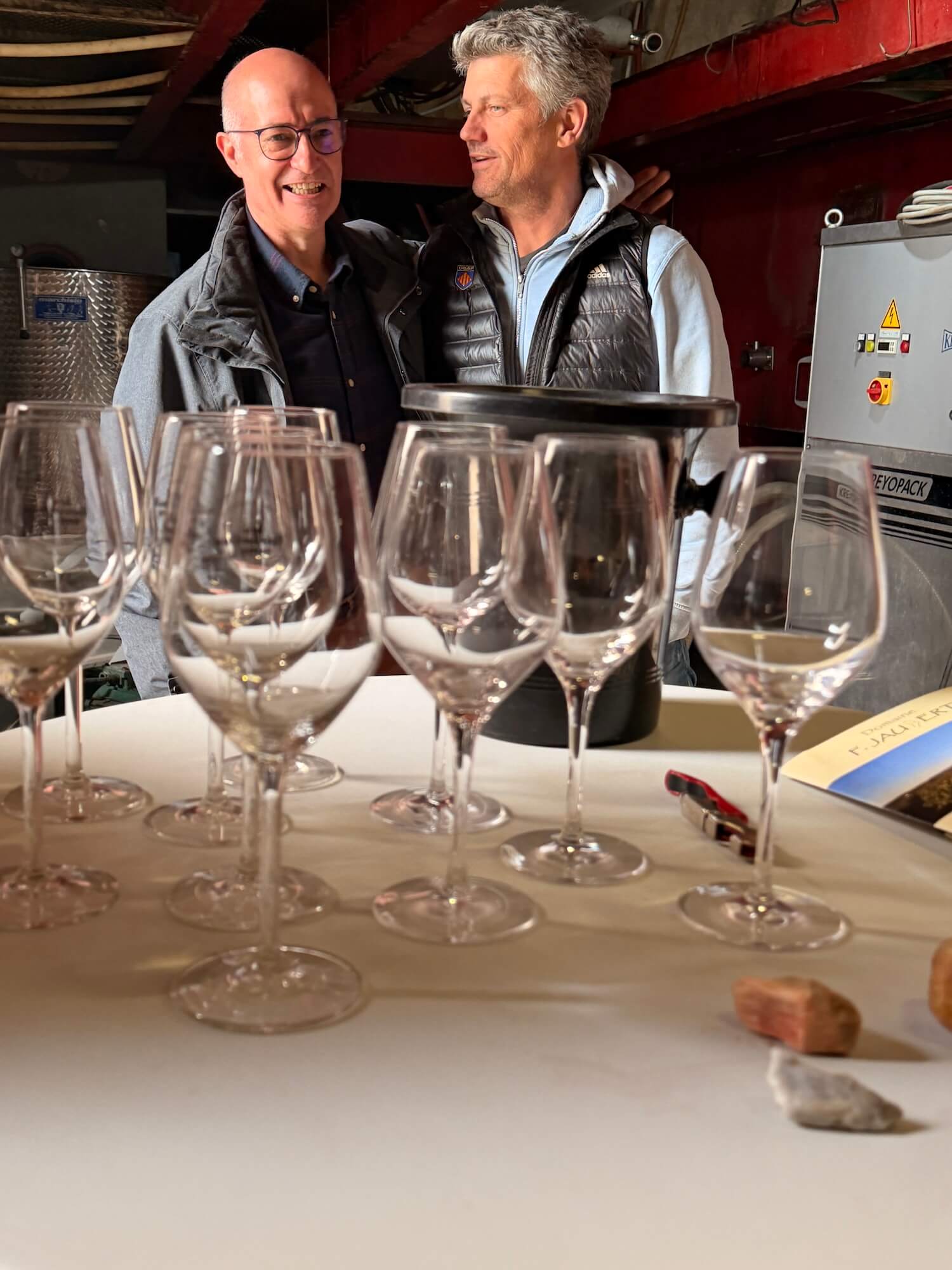
Inside, we were greeted by the winemaker, a longtime acquaintance of Eric Aracil, who welcomed us despite being in the midst of preparing a private four-course lunch for clients.
The menu—featuring lamb, duck, and other regional dishes—was clearly designed with wine pairings in mind. Mention of this upcoming feast added an immediate sense of the estate’s priorities: hospitality, precision, and a close relationship between food and wine.
The tasting itself moved through whites, reds, and the region’s traditional sweet wines. The latter were exactly what one would expect—technically sound, historically consistent, and aligned with what many of us had studied.
But it was the dry white wines that shifted the conversation.
These were not merely good; they were compelling. High in acidity, structured, and marked by a distinct mineral character, they showed a level of precision and complexity that felt closer to the great white wine regions than to the stereotypes often associated with Roussillon.
There was a clarity and tension to them that demanded attention. While comparisons to places like Burgundy must always be made carefully, the quality here was undeniably in that conversation.
If Château de l’Ou represents a thoughtful balance between modernity and tradition, the second visit offered something close to its opposite.
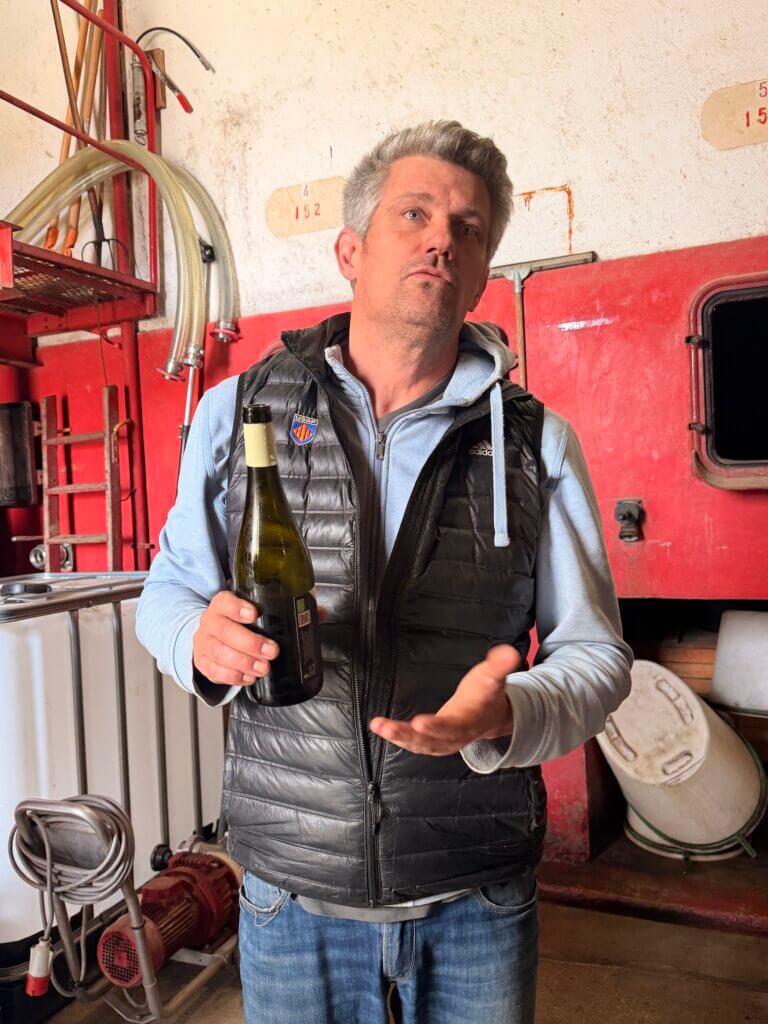
At Domaine de l’Oncle Jules, the experience began in the vineyard itself. The landscape here is stark—open, exposed, and undeniably rugged.
The winemaker led us through the terrain, focusing on the soils and conditions that define the wines. His presence was notable: articulate, engaged, and perhaps unexpectedly polished for someone so deeply rooted in such a remote environment. It was a contrast that mirrored the broader themes of the visit.
The winery facilities themselves felt almost frozen in time. Old cement tanks, likely dating back decades, dominated the space. The structure had none of the design elements now common in contemporary wineries—no architectural statements, no curated aesthetics.
Instead, it conveyed a sense of continuity, as though the focus had remained unchanged for generations.
And yet, the wines told a different story.
The whites here were again of high quality—comparable in precision and energy to those at Château de l’Ou—but it was the reds that stood out most clearly. A 100% Grenache, in particular, captured the essence of the site: concentrated yet balanced, expressive without excess.
It demonstrated how effectively traditional methods, when applied with care and understanding, can produce wines of real distinction.
Taken together, the two visits revealed a broader truth about Roussillon. This is a region defined by both modern and deeply traditional philosophies, both polished and rustic expressions.
What unites them is a commitment to quality that challenges outdated assumptions.
Roussillon remains what it has always been: wild, varied, and deeply tied to its landscape. But it is also evolving with exciting moments ahead for its future.