Roussillon Wines
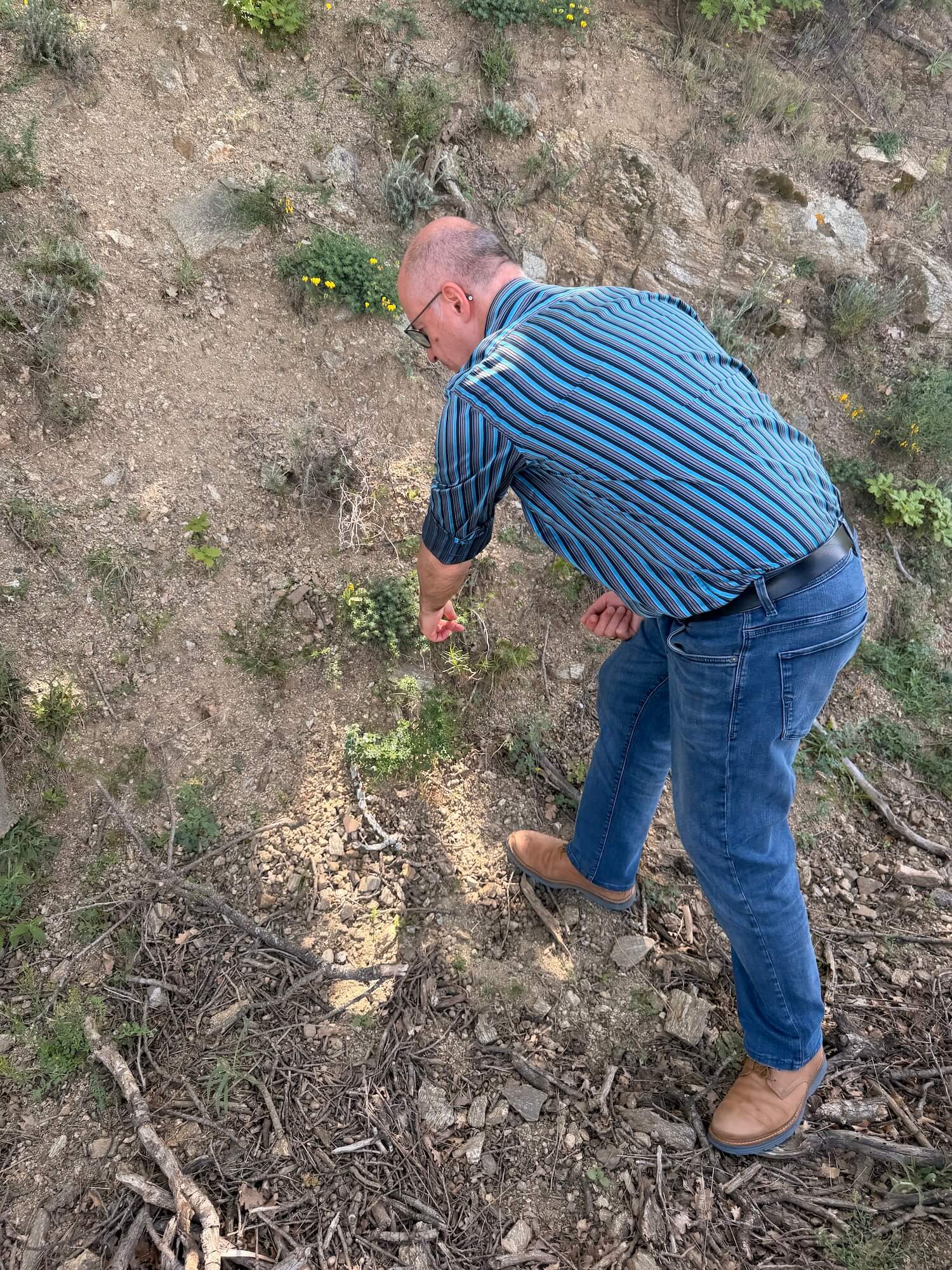
Call it strange, yet I often think of Eric Aracil, export manage for Wines of the Roussillon as a “witch doctor” of sorts. The reason I say this is because he knows every herb in the Roussillon. He also knows volumes about every kind of soil in the region and how it shapes the wine.
This is why it’s so much fun to go on excursion with him—to explore the nuances of Roussillon.
That thought stayed with me from the moment we left Hôtel Mercure Perpignan Centre early in the morning, and it defined the entire day.
The night before had already set the tone. Dinner at Restaurant Le Vienne was delicious and precise—house-smoked salmon, cod, and a series of bright, high-acid white wines that reminded me how well this region handles freshness despite its reputation for power.
By 8:30 a.m. the next morning, I was energized. The weather had shifted dramatically—hail the night before, clear sun in the morning—and everyone dressed accordingly.
I wore summer clothes in late April, but carried a heavy coat and umbrella, which turned out to be the correct instinct.
In the Roussillon, the weather is not a backdrop. It’s a participant.
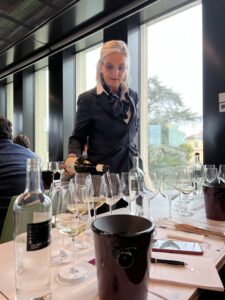
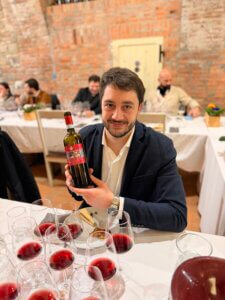
Our group, the Association of Wine Educators, included wine educators from around the world. We turned out to be a collection of geeky types and more mainstream types, yet we all took notes carefully, listened closely, and discussed the wines with intention.
As we drove into the Vallée de l’Agly, Eric narrated the passing landscape in his measured, deliberate rhythm. He would point out apricot trees, slopes, exposures, and most importantly, soils.
Black schist. White schist. Red schist. Gneiss. Limestone. Sometimes layered together in ways that seemed almost geological improvisation.
Eric notices things most people walk past. A tiny herb, barely visible against the rock, could become a thirty-minute explanation. Not because of the plant itself, but because of what it represents.
This could mean how it reflects the soil, the moisture, the stress of the vine.
That’s why I think of him as a “witch doctor.” Not in a mystical sense, but in the way he understands the relationship between land and outcome with an instinctive precision.
At several points, he pulled us off the road to have us smell the herbs growing between jagged rocks. The ground was uneven, the edges sharp, and the drops nearby were real.
But that’s also the point. This is not a controlled environment. The landscape is dramatic—mountains pushing upward, some still snow-capped in April, under a sky that can turn without warning.
It remains my favorite landscape in the world because it feels alive.
Untamed. Slightly unpredictable.
At Domaine Chapoutier, we were hosted by Aurélien Capel, whose quiet presence contrasted with the scale of the estate. Soft-spoken, composed, and understated, he led the visit without drawing attention to himself.
In the Chapoutier vineyard, Eric said something I interpreted to mean that when you taste the texture of a wine, you are tasting the texture of the rock. I could have misunderstood him, so this is my interpretation not a direct quote.
I believe he also said that when you look at a rock, you can imagine the texture of the wine.
Whether or not this holds up under scientific scrutiny, it felt true in practice.
We continued through Cassagnes and Caramany, where the terrain shifts constantly—rocky, exposed, almost severe in places.
Lunch were sandwiches enjoyed under the Ansignan Aqueduct, a massive Roman structure still standing after two thousand years.
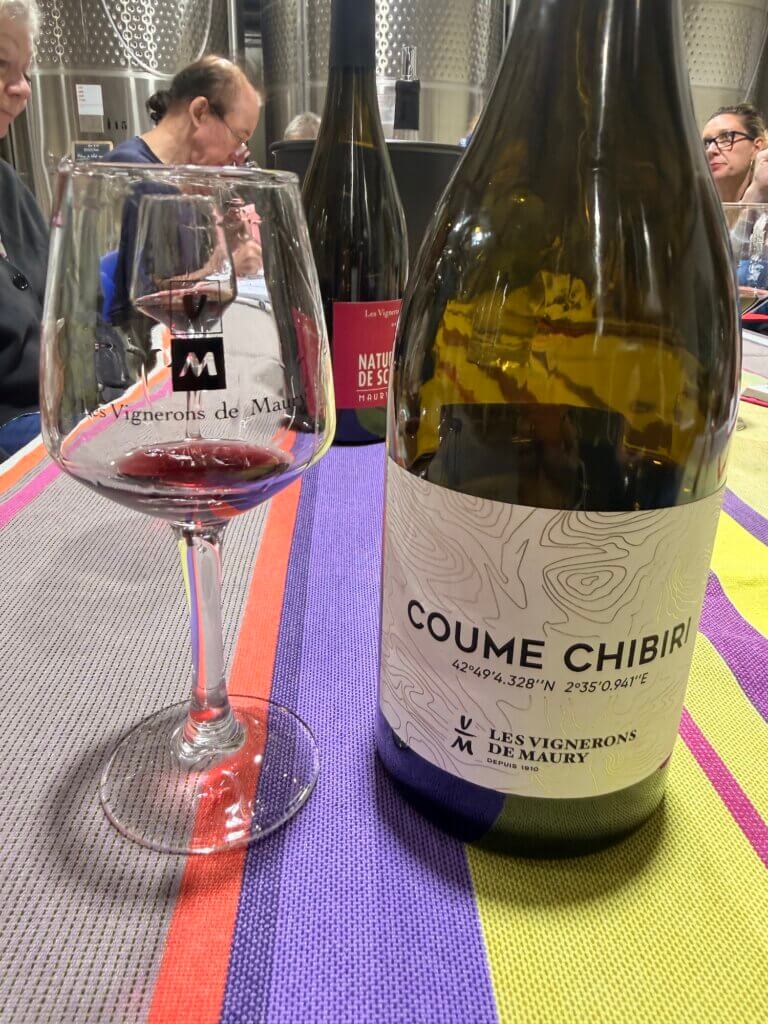
At Les Vignerons de Maury, expectations shifted again.
Cooperatives are often associated with volume over quality, but the wines here challenged that assumption. The reds, particularly from local varieties like Carignan and Grenache, showed depth and structure, while the fortified Maury wines maintained balance without tipping into excess sweetness.
By the time we reached Domaine Cazes, the tone had changed slightly. The tasting was efficient, focused, and by dinner at La Table d’Aimé, the group had shifted from analysis to reflection and a discussion of this fantastic insightful day.
It had been a full day, but what stayed with me was not just the wines or even the producers.
It was the interplay between landscape, weather, soil, and the delicious wines it creates.