Romanelli Family in Montefalco
Romanelli is a classic winery where the story, the land, and the winemaker paint a lovely picture as soon as you enter.
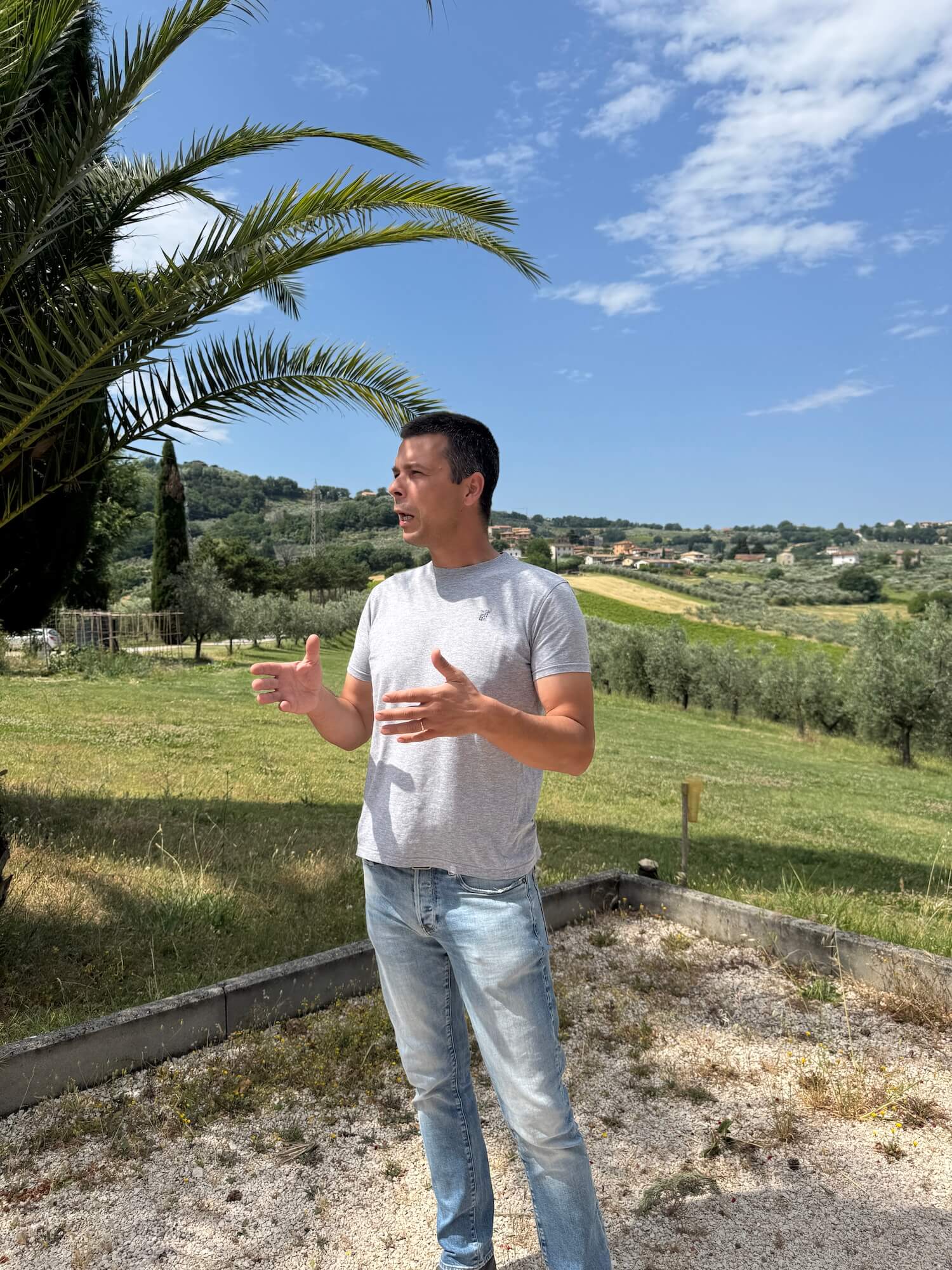
That was the feeling I had during my visit to Romanelli, located high on Colle San Clemente, just outside Montefalco.
It’s not far from other wineries geographically. Yet in terms of atmosphere, Romanelli feels worlds apart.
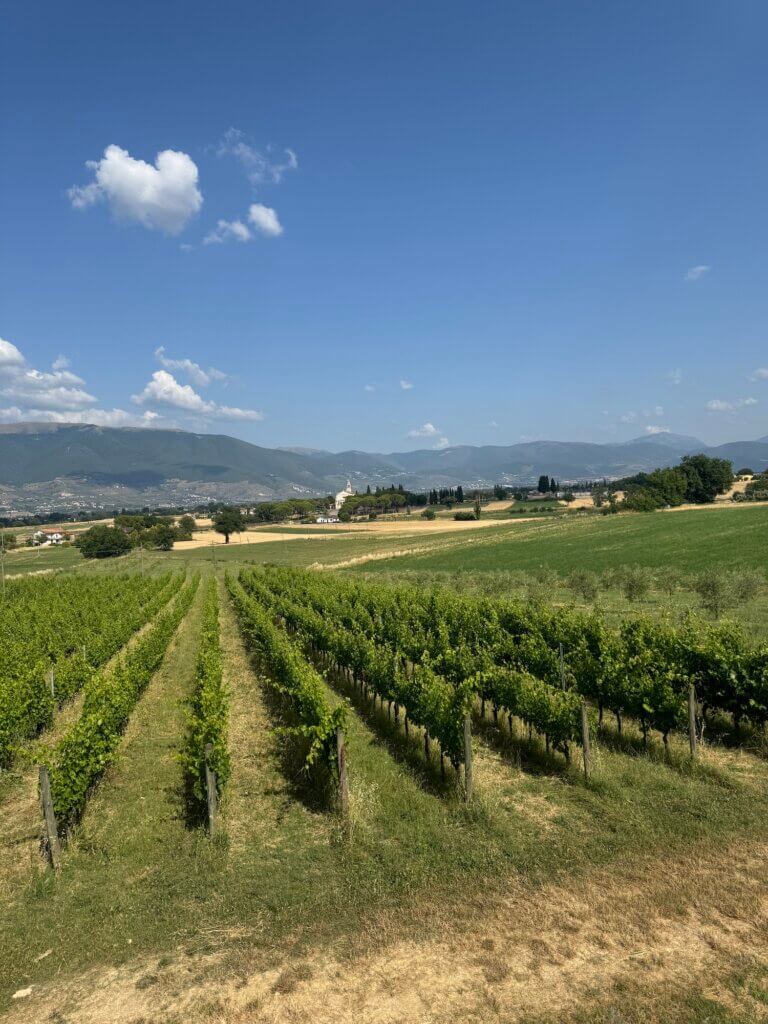
Sitting at the top of the hill, it offers something rare in wine country: a true aerial view.
Look in any direction and you’re surrounded by a 360-degree sweep of vineyards, rolling out in organized lines like living calligraphy. It’s a place that seems intentionally placed for reflection.
And Devis Romanelli, who runs nearly every part of the operation himself, brings that same intentionality to his wines and to the way he tells their story.
Devis’s connection to this land runs deep. His grandfather, in the 1970s, transitioned the family’s work from animal husbandry into olive oil—and finally wine.
Today, Romanelli still produces some of the area’s most traditional wines: Montefalco Sagrantino, Montefalco Rosso, Grechetto, and the increasingly praised Trebbiano Spoletino. But everything here is done with the eye of someone not just preserving tradition, but giving it form, and feeling.
That personality comes through immediately—not just in the wines, but in Devis himself. Over the course of the visit, he guided our small group of journalists through a vertical tasting: four vintages of Trebbiano Spoletino and four of Sagrantino. Each was poured with an almost reverent precision, followed by vivid commentary on the growing conditions of that year, the choices made in the cellar, and the result in the bottle.
Beyond the technical clarity, what stood out was the depth of feeling. Devis recalled each year like a chapter in a novel — with weather patterns, ripening curves, and cellar decisions woven into a quiet, poetic narrative.
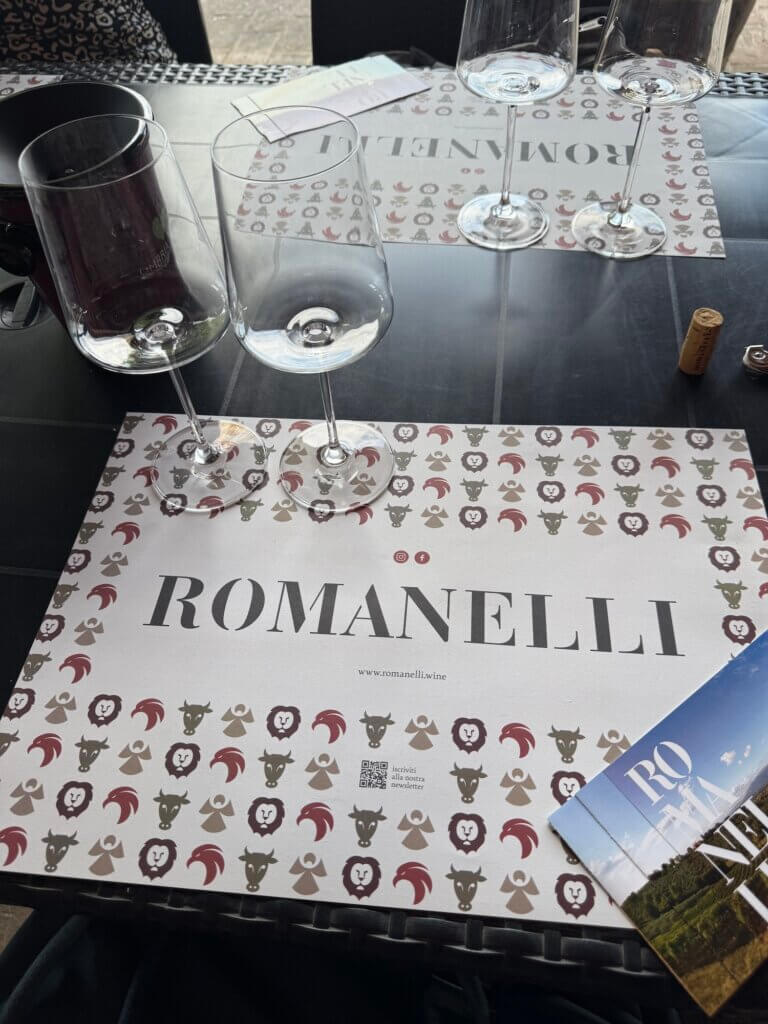
One detail I couldn’t ignore — even before the wines arrived — were the cryptic symbols printed across the placemats. Not just abstract flourishes. They were drawn from one of Devis’s favorite frescoes, painted by Benozzo Gozzoli in Montefalco’s Church of San Francesco.
The fresco, featuring the four evangelists—Matteo, Marco, Luca, and Giovanni, represented as a winged man, lion, ox, and eagle—now appears prominently across Romanelli’s new wine labels. “We wanted the labels to speak about something older than wine,” Devis explained. “To show how the land shaped us, even before we started shaping the land.”
That idea — the land shaping the winemaker — is evident in everything Romanelli produces. The estate is farmed with organic principles and an eye toward biodiversity, not trend. Each wine is a study in balance. From the more delicate floral lift of Grechetto to the powerful structure of Sagrantino, the house style is respectful—of the grape, the place, and of nature’s variability. Perfection may be the ambition, but respect is the foundation.
Trebbiano Spoletino, a grape native to this pocket of Umbria, is gaining attention from wine lovers for exactly this balance: aromatic but structured, fresh but ageable. The versions we tasted spanned increased intensity with vintage, moving from citrus and herbs to more tropical notes and the faintest whisper of smoke and dried stone fruit. Each year expressed something different, reflective of both harvest timing and cellar approach.
Sagrantino, Montefalco’s muscular red calling card, showed equally well — though, in Devis’s hands, the wine was a little sleeker, the tannins controlled, the power balanced. Sagrantino can often overwhelm with tannin, yet here, it seemed tamed, not neutered — dense, yes, but elegant. Again, restraint over impact.
And that, I suspect, is what makes Romanelli feel different. You’re not walking into a polished room with a marketing team’s voice leading the tasting. You’re listening to one person talk through a project that he knows down to the rootstock.
The bottles don’t just represent wines. They represent seasons, memories, hard choices, long views. The fact that Devis executes nearly every part of the business himself — from farming to winemaking to guiding tastings — only reinforces that connection between vineyard and voice.
It was, in every way, a grounded visit. But it was also romantic — and not just because of the spectacular views. Devis speaks with a kind of romantic sensibility, about vines, about history, about his family’s decision to stay in Montefalco while others left, and about his desire to make wines with character, not just consistency.
You leave Romanelli not just with a deeper understanding of Montefalco’s native grapes, but with a sense that wine—done this way—is still a deeply personal expression. Not scaled, not smoothed out. Just spoken, from vine to bottle, like a story he’s still writing.