
Wines of Catalonia
Catalonia may be part of Spain, but when it comes to wine, culture and identity, it is very much a region unto itself.
Catalonia’s secrets were revealed in the masterclass and tasting called Discover the Best Wines of Catalonia.
The event was held at the historic La Nacional, initially founded in 1868 as the Spanish Benevolent Society. In the tasting room, one could see historic black-and-white photographs lining the rooms recall an earlier era of Spanish community life.
It also offered a preview of Barcelona Wine Week, taking place in early February of 2027.
The masterclass was presented by Catalan wine expert Lucas Payà, whose impressive career includes working as a sommelier at Ferran Adrià’s legendary elBulli restaurant. Introducing him was Marcos Gonzalez, Director of Catalonia Trade & Investment.
Geography Changes Everything
Catalonia occupies a relatively compact area, yet its geography changes rapidly.
Payà pointed out that in little more than an hour it is possible to travel from the Mediterranean coastline to elevations of more than 10,000 feet in the Pyrenees.
That creates an extraordinary range of growing conditions.
Some vineyards experience a distinctly Mediterranean influence, while others are affected by altitude, continental conditions, significant differences between daytime and nighttime temperatures, and much cooler growing environments.
That geographic diversity helps explain why it is difficult to talk about “Catalan wine” as though it represents one particular style.
Looking Back to Indigenous Grapes
Another important change is happening in the vineyards themselves.
For decades, international grapes such as Chardonnay, Cabernet Sauvignon, Merlot and Syrah were planted throughout many European wine regions, including Catalonia.
Today, the direction is increasingly turning back toward native grapes.
Payà pointed to the growing importance of Xarel·lo, once thought of primarily as one of the traditional grapes used for Cava, but now increasingly valued as a serious still white wine grape.
White Garnacha is also receiving greater attention, along with red Garnacha and other indigenous varieties.
That was one of the most convincing parts of the tasting upstairs.
The white wines were particularly impressive. They were complex, beautifully crafted and capable of delivering considerable dimension.
The character was already in the grape.
At a time when even an introductory white Burgundy can exceed a hundred dollars, these wines also offered an interesting reminder that complexity, acidity and a full palate can come from less internationally famous grapes and regions.
A Different Approach to Maturation
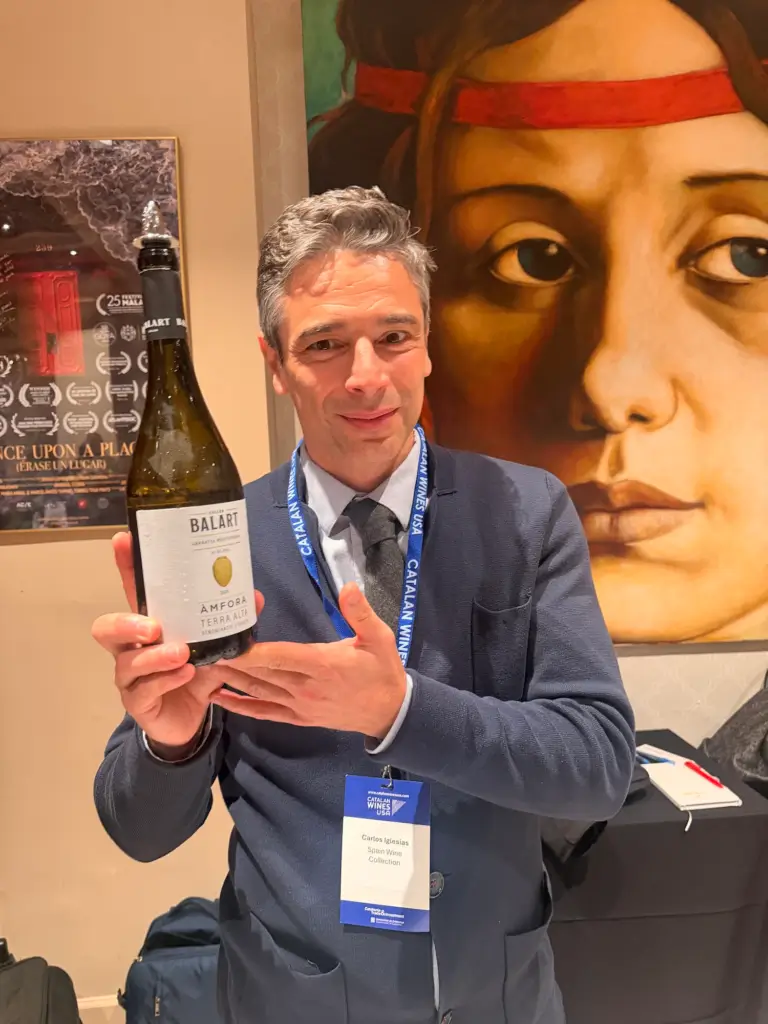
One discovery were the producers using amphora for maturation, especially for their white wine.
Amphora occupies an interesting position between stainless steel and oak. Its porous surface allows a measured interaction with oxygen, helping develop texture and richness, but without adding the flavor of oak.
For wines based on indigenous varieties, that can be especially valuable. The vessel contributes to the development of the wine without overwhelming the personality of the grape itself.
The reds showed the same combination of freshness, acidity and depth that impressed me in the whites.
And the sparkling wines were equally compelling. The best Cavas showed freshness, complexity and elegance that made them serious alternatives not only to Italy’s top sparkling wines but, in some cases, to Champagne.
Perhaps the most intriguing development is taking place in Priorat.
Rather than treating every wine within the appellation as essentially equal, Priorat has developed a hierarchy based increasingly on where the grapes are grown.
The system progresses from regional Priorat through village and specific-site wines to Vinya Classificada and finally Gran Vinya Classificada.
It is difficult not to think of Burgundy.
The underlying idea is similar: as the geographic origin becomes more precise, the identity of the individual site becomes more important.
For a region already known for powerful and distinctive wines, it represents another step toward defining quality through place rather than simply winemaking technique.
That may ultimately have been the most interesting message of the afternoon.
From the presentation today, Catalonia has technology, talented winemakers and centuries of experience. Along with delicious and affordably priced wines.