Mestral Olive Oil
After years of visiting wineries around the world, I finally had an opportunity to see how olive oil is produced.
The occasion was a visit to Mestral, an olive oil cooperative in Cambrils, Spain, during the International Food Tourism Conference (IFOODTC).
I wasn’t quite sure what to expect. Perhaps an olive grove with a picturesque farmhouse and a traditional olive press.
Instead, our bus pulled up outside a large industrial facility with little signage. The name Mestral appeared on a company truck parked outside.
It certainly wasn’t a romantic introduction to olive oil production.
But once inside, I discovered something surprisingly familiar.
An Industrial Surprise
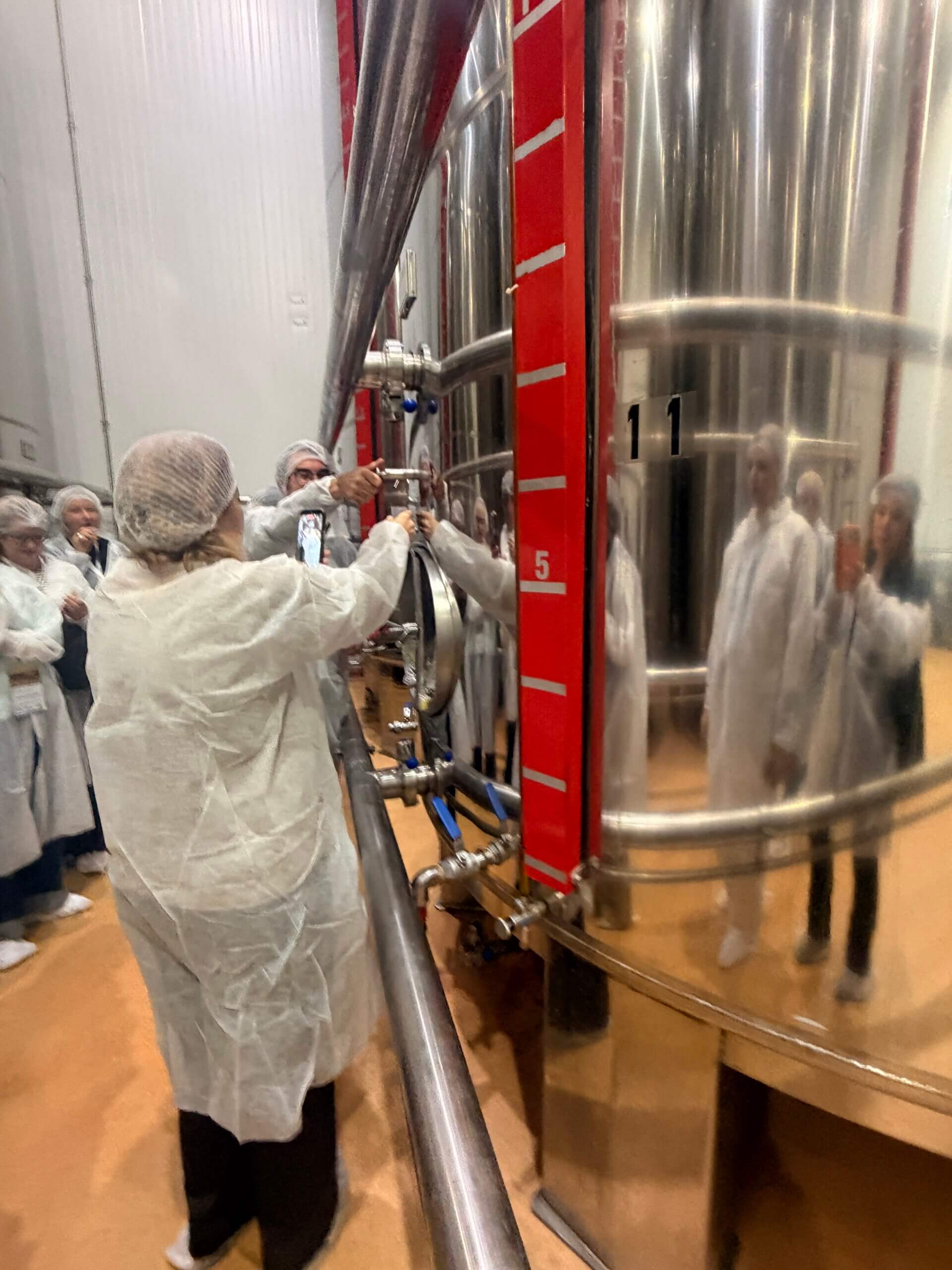
Before entering the production area, everyone was required to put on protective clothing covering our hair, bodies and shoes.
Our guide led us through a series of rooms filled with large stainless-steel tanks, pipes and sophisticated machinery.
I felt almost as though I were visiting a modern winery.
The resemblance was striking. Some of the equipment even looked similar to machinery I’d seen in wine production facilities.
Of course, grapes and olives require entirely different treatment. But both industries depend on carefully controlled processing to preserve the quality of their agricultural products.
Mestral is part of the Cooperativa Agrícola de Cambrils, which produces extra-virgin olive oil, particularly from Arbequina olives, a variety widely associated with Catalonia.
The modern production process begins when olives arrive from the groves. They are cleaned and crushed into a paste. This paste is gently mixed before the oil is separated from water and solids, generally using centrifuges.
Unlike wine, olive oil doesn’t undergo fermentation. The objective is to extract the oil while preserving its freshness, flavor and natural characteristics.
Our guide explained the various stages as we moved from room to room.
Seeing the entire operation firsthand gave me a new appreciation for what happens between harvesting an olive and opening a bottle of extra-virgin olive oil.
Fresh From the Tank
One of the highlights came when our guide opened a spigot on a large stainless-steel vessel and poured a small amount of freshly produced olive oil for each visitor.
There was no bread or elaborate presentation.
We simply tasted the oil as it came from the tank.
It tasted remarkably fresh.
I wouldn’t pretend to judge its quality from that brief sampling, but experiencing olive oil directly from the production equipment was an unexpected highlight.
Afterward, we returned outdoors for a casual reception featuring bread, cheese, olive oil and wine.
And that was where I made another interesting discovery.
A Priorat Winemaker
Standing behind a small table displaying several bottles was Cristian Francès, an independent winemaker from Torroja del Priorat.
He had brought a selection of wines from his winery, Celler Cristian Francès, for conference visitors to taste.
Naturally, I was intrigued.
Cristian explained that his parents and grandparents had grown grapes in Priorat for generations, delivering their harvests to a cooperative rather than producing wine under their own label.
He decided to take a different direction.
Instead of selling all his grapes to a cooperative, he became the first generation in his family to produce and bottle wine independently.
For anyone familiar with the demanding terrain and celebrated wines of Priorat, that represents a considerable undertaking.
Cristian poured several wines, including reds made from Garnacha and Carignan, two of the region’s principal traditional grape varieties.
Both were excellent.
I have a particular fondness for Carignan, and his expression of the grape was especially enjoyable.
What interested me almost as much as the wines was his family story.
Within the space of an afternoon, I’d visited a substantial agricultural cooperative …
… then met a talented winemaker whose family had participated in the cooperative system for generations before he chose to establish his own winery.
Two different approaches to agricultural production, each with a place in Catalonia’s food and wine culture.
And what better way to end my first olive oil factory tour than with a glass of excellent Priorat Carignan?