Terre de la Custodia
By the time I reached Terre de la Custodia, just outside Montefalco, I thought I had a handle on Umbrian family wineries. Then I met brand ambassador Daniele Sevoli and discovered that here, the story starts not with vines but with olives—and with a family whose roots stretch back to 1780.
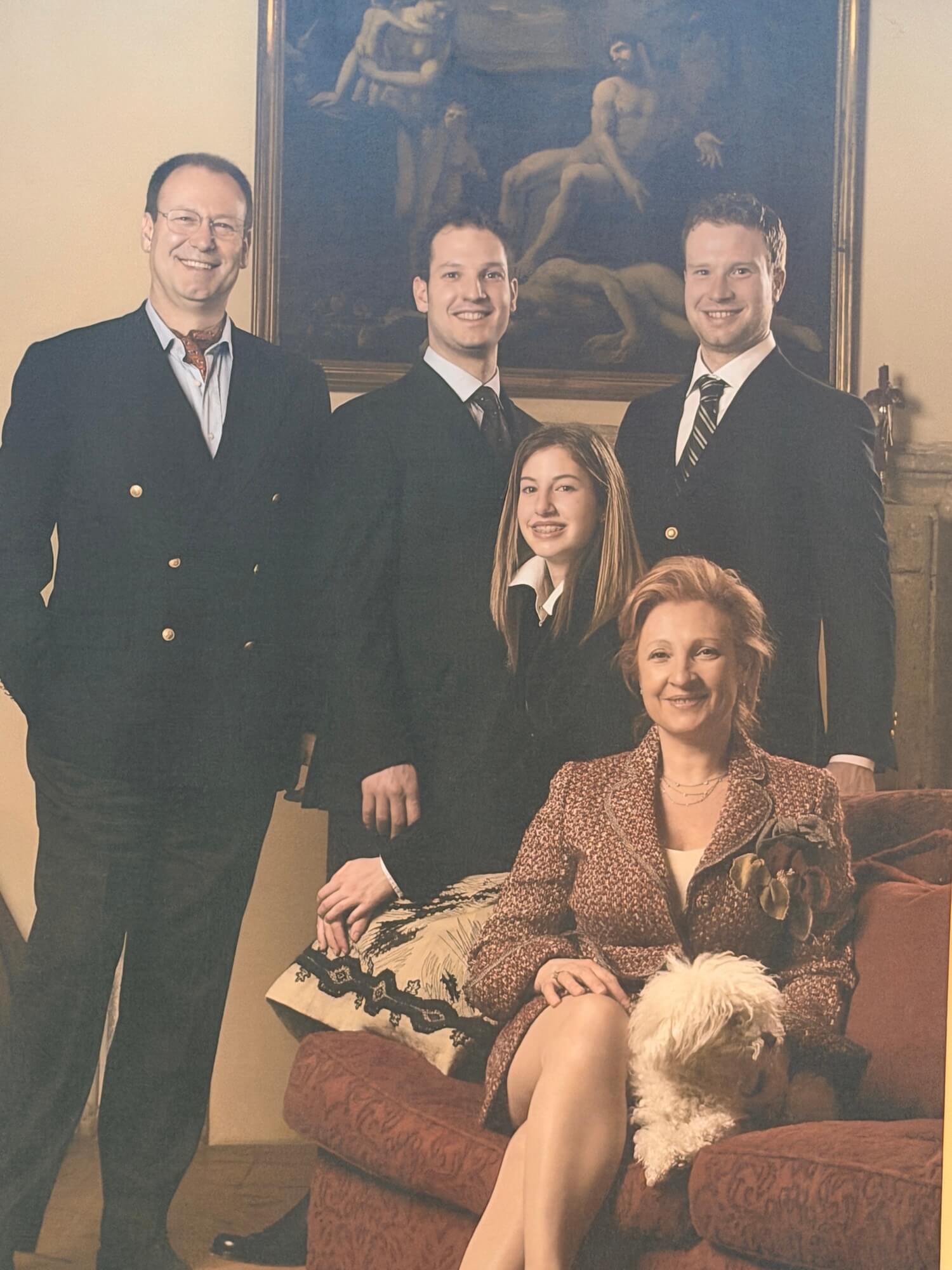
Terre de la Custodia is part of the Farchioni group, a name Italians usually associate with extra‑virgin olive oil rather than the grape varieties of the Montefalco region.
For centuries the Farchioni family has farmed Umbria, becoming one of the country’s leading olive oil producers. They have thousands of hectares under olives and cereals and bottles on supermarket shelves across Italy.
Wine, Daniele explained, came later, as a natural extension of the family’s instinct to “harvest the fruits of our hills and turn them into something precious.”
The modern winery at Palombara, in the hills of Gualdo Cattaneo about five kilometres from Montefalco, is the visible symbol of that decision.
The Farchioni built a major new olive‑oil facility in 2004 and, soon after, invested in a purpose‑built cellar for Terre de la Custodia, surrounded by new vineyards.
Today those vineyards cover around 120 hectares in the Montefalco and Todi zones, planted to Sagrantino, Sangiovese, Grechetto, Spoletino and a touch of international varieties, producing over a million bottles a year.
Yet for all that scale, what you feel on the ground is a surprisingly tight family focus—and a clear hierarchy of wines.
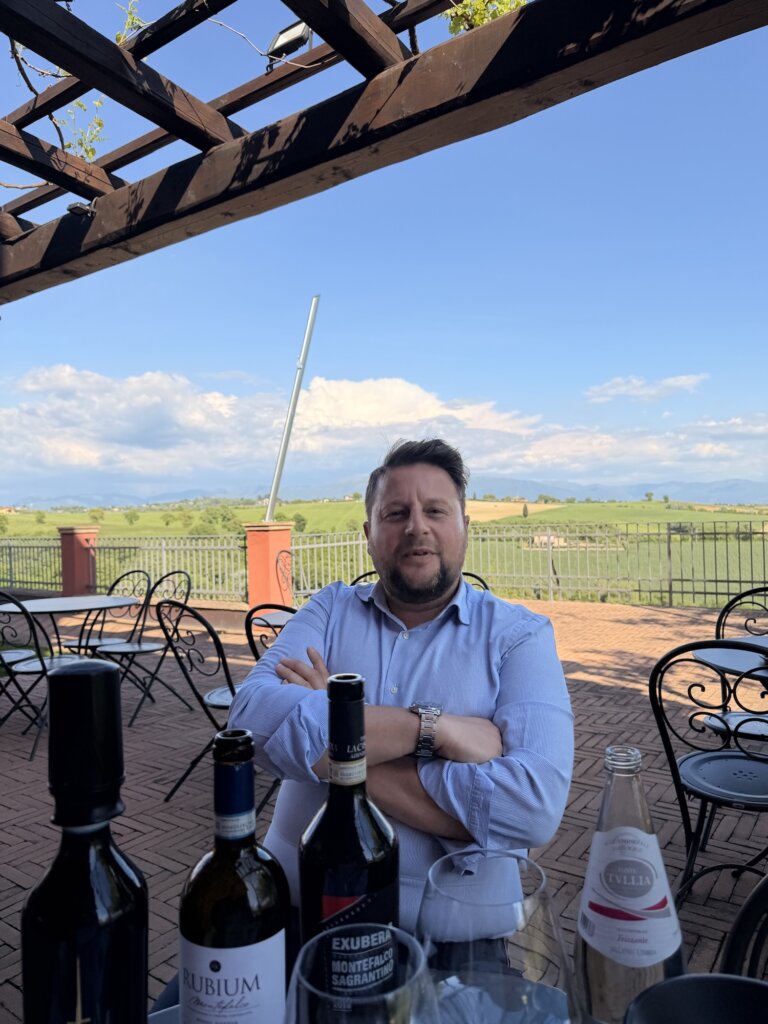
Daniele talked me through three levels in the range. At the base are the entry wines, designed to be accessible and “daily,” but even these carry Latin‑evoking names that nod to the region’s layered history. Above them sits a middle tier that includes a Montefalco Bianco DOC called Plentis, and at the top are the cru‑style selections, among them a Trebbiano Spoletino and a flagship Montefalco Sagrantino called Exubera.
Everything, Daniele stressed, is built to express a specific piece of land rather than an anonymous house style.
We began with the Trebbiano Spoletino, Nubite 2024, a wine that neatly encapsulates Terre de la Custodia’s blend of tradition and precision. Spoletino is an ancient local white variety associated with the area around Spoleto. It has been rediscovered in recent years for its natural acidity and texture, and here it never appears under the generic “Trebbiano” name, only as Spoletino.
Nubite 2024 spent around six months in stainless‑steel vats before bottling, resulting in a fresh, luminous white. In other tastings it has shown notes of field flowers, yellow apple and fern, carried by a crisp, satisfying palate that makes it an easy pairing for young Umbrian cheeses. In the glass it felt like a clean, modern expression of a very old grape.
From there we moved to Plentis, Montefalco Bianco DOC 2022, a wine that sits at the “middle” level but feels almost aristocratic. Plentis is a blend of Spoletino, Grechetto and Chardonnay from hillside vineyards in the Montefalco area, vinified and aged patiently to let the texture catch up with the aromatics.
In a recent vintage, critics have described it as “full” and harmonious, with exotic fruit, herbs and enough structure to stand up to dishes as rich as pasta with sea urchin or semi‑aged cheeses. Tasting the 2022, you could feel that same generosity: a white with breadth and persistence rather than just a flash of fruit.
Montefalco Rosso 2018 followed, a classic blend led by Sangiovese with Merlot and Sagrantino—your notes recall roughly 70% Sangiovese, 15% Merlot and 15% Sagrantino, which matches the estate’s stated approach of combining local backbone with a touch of international polish.
The vineyards around Palombara sit at about 300 metres above sea level on light, south‑facing hillsides with clay soils rich in lignite, conditions that give both ripeness and structure.
In the glass, the Rosso showed exactly that balance: red‑cherry fruit and spice from Sangiovese, a little rounded mid‑palate from Merlot, and a firm, distinctly Umbrian grip from Sagrantino.
But it was Exubera, Montefalco Sagrantino DOCG 2018, that crystallised the Terre de la Custodia philosophy for me. Exubera is a relatively new project, launched in the mid‑2010s as a collaboration between the new generation of the Farchioni family—Jean Paolo, the eleventh generation—and the team on the ground, including Daniele.
The idea was to craft a Sagrantino that remained unmistakably powerful but achieved an unusual balance, with tannins that were structured yet polished enough to make the wine enjoyable well before its tenth birthday.
The grapes come from older vineyards directly in front of the winery, with ideal exposure and a proven match between Sagrantino and site. Bunches are hand‑selected and harvested into small 15‑kilogram crates, then fermented in stainless steel with selected yeasts to keep the fruit focused and clean.
After fermentation, Exubera spends around 18 months in barriques and tonneaux, followed by years of bottle aging—up to five in some releases—before it reaches the market. On the estate’s own technical notes, the 2018 is described as an “intense ruby” wine that explodes with ripe red fruits and field violets, layered with eucalyptus, licorice, white pepper and cinnamon, warm and enveloping on the palate with a powerful but harmonious tannic weave and a long, elegant finish.
Tasting it with Daniele, I could see why they call Exubera their “rock” Sagrantino: it has the amplitude and swagger you expect from the grape, but the edges are smoothed just enough that you find yourself going back to the glass rather than taking notes on its tannins.
It is also, as Daniele joked, the perfect wine for Jean Paolo, who loves the 1950s and drives classic cars in a leather jacket—Exubera feels like a Sagrantino that might have a vintage soundtrack and chrome trim if it could.
What struck me most about Terre de la Custodia is how naturally all these layers fit together: centuries of farming that began with olive trees, a thoroughly modern winery entrusted to a star consultant like Riccardo Cotarella, a range that runs from fresh, stainless‑steel Spoletino to a barrique‑aged Sagrantino built to last.
Sitting there with Daniele, the Assisi mountains hazy in the distance and rows of vines descending from the hill like green terraces, the project felt like the logical next chapter in a very long Umbrian story. One where the land itself remains the protagonist.