
Volcanic Wines
“The vineyard plot gets its name from rocks so sharp they can cut your hand. That’s the story of Volcanic wines,” says winemaker winemaker Angelo Di Grazia as he spoke about the terroir of Tornatore winery in Sicily.
This was the dramatic introduction to the Volcanic wines of Sicilia.
Jancis Robinson organized this Volcanic Wines event held at the popular event space and restaurant Manhatta.
The four tasting Volcanic Wines masterclasses served as a first-class ticket to the wines and terroir of the Sicilian region.
This seminar was called “The Long Memory of the Earth” and moderated by Suzanne Donovan-Brown of Maze Row Merchant.
It brought together two very different expressions of volcanic terroir.
Rather than presenting a range of producers, the organizers chose a more revealing approach—vertical tastings of a single vineyard wine from each region.
The white wines came from Pieropan’s Calvarino vineyard in Soave, represented by the 2024, 2017, and 2013 vintages. Discussing them was Doug Miller, senior sales manager for Lux Wines.
Mr. Miller explained that the Calvarino vineyard is famous because it produced Italy’s first-ever single-vineyard white wine in 1971.
This pioneering release revolutionized the Soave region, proving that Italian white wines could highlight distinct terroir and improve with age.
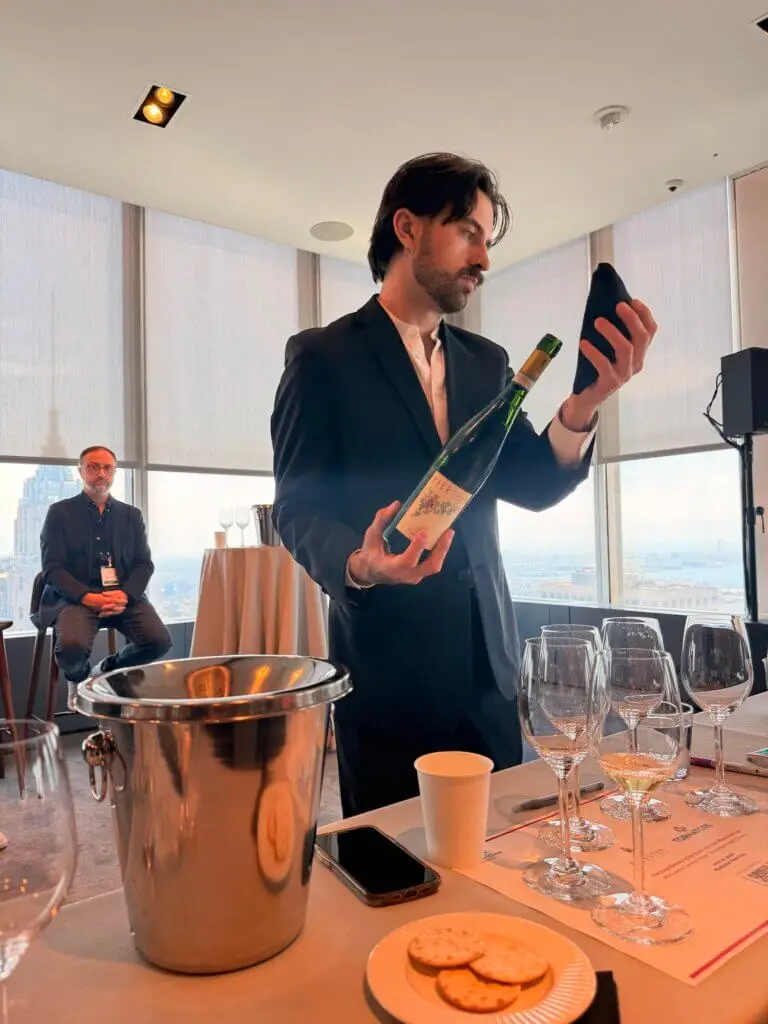
Winemaker Angelo Di Grazia introduced the red volcanic wines from Tornatore’s Pietrarizzo vineyard on Etna, represented by the 2021, 2019, and 2017 vintages.
The comparison offered a fascinating lesson not only in volcanic soils and also in how wines evolve over time.
Soil Age
One of the most interesting observations of the afternoon came from the discussion of soil age. While both regions are volcanic, they represent dramatically different geological histories.
In Calvarino’s Soave, the volcanic activity ceased millions of years ago. The soils have been weathered, eroded, and transformed over immense stretches of time.
In contrast, Etna remains an active volcano, continually reshaping its landscape through new lava flows and fresh deposits of volcanic ash.
The result is that both regions produce distinctive wines, but the expression of volcanic character differs significantly.
For the Pieropan Calvarino vertical, presenters emphasized that Garganega requires time to reveal its full personality. The younger 2024 showed nervous energy and tightly wound structure. The 2013 demonstrated maturity and evolution. For me, however, the standout was the 2017.
The wine combined racy acidity with impressive concentration and tension. It was fuller-bodied than I expected yet remained remarkably balanced.
The finish lingered long after each sip, moving from citrus and savory notes into a complex, almost electric persistence.
It was easy to understand why the presenters described volcanic wines as possessing a unique sense of “energy”—a term that may sound imprecise until one experiences it in the glass.
That concept of energy surfaced repeatedly throughout the tasting.
It was not simply acidity. Instead of a descriptor for simple acidity, the word described the way these wines moved across the palate. That they carryied flavor and structure with unusual vitality.
Another memorable insight came from the Pieropan team, who compared the three vintages to photographs of the same person at different stages of life.
Rather than judging one as superior to another, the exercise encouraged us to appreciate how a vineyard expresses itself over time like a high school student to a college coed.
The discussion then shifted south to Sicily and Tornatore’s Pietrarizzo vineyard on Etna.
Winemaker Angelo Di Grazia provided a compelling perspective on working with an active volcano.
Far from viewing Etna as a threat, he described it almost as a living partner. New eruptions continually contribute fresh volcanic material to the soils.
All this while the mountain’s elevation and dramatic day-night temperature shifts help preserve freshness in the grapes despite increasingly warm growing seasons.
Pietrarizzo is planted at approximately 700 meters above sea level and devoted entirely to Nerello Mascalese.
The vineyard’s rocky volcanic soils and high elevation produce wines that many tasters compare to fine Pinot Noir or Nebbiolo, though they remain distinctly Sicilian in character.
Tasting the three vintages side by side illustrated how vintage conditions shape the expression of a site. The 2017 reflected a particularly hot and challenging growing season.
The 2019 was described as nearly ideal, producing exceptional balance and elegance. The 2021 seemed to bridge the two styles, combining fruit intensity with freshness.
What impressed me most was the transparency of the wines. Di Grazia wanted the vineyard to speak for itself, intervening as little as possible in the cellar.
Concrete fermentation vessels, careful aging, and restrained winemaking all served the same purpose: preserving a sense of place.
That philosophy connected both producers despite the vast distance between them.
As a wine writer and educator, I left with a renewed appreciation for vertical tastings.
I also left with a broader understanding of volcanic wines. And reinforcing that ancient volcanic soils in Soave and active volcanic soils on Etna produce very different wines. What they share is a remarkable sense of vitality, precision, and identity.