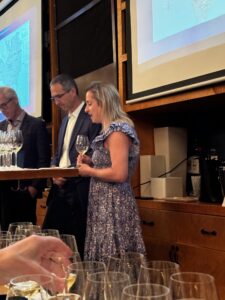
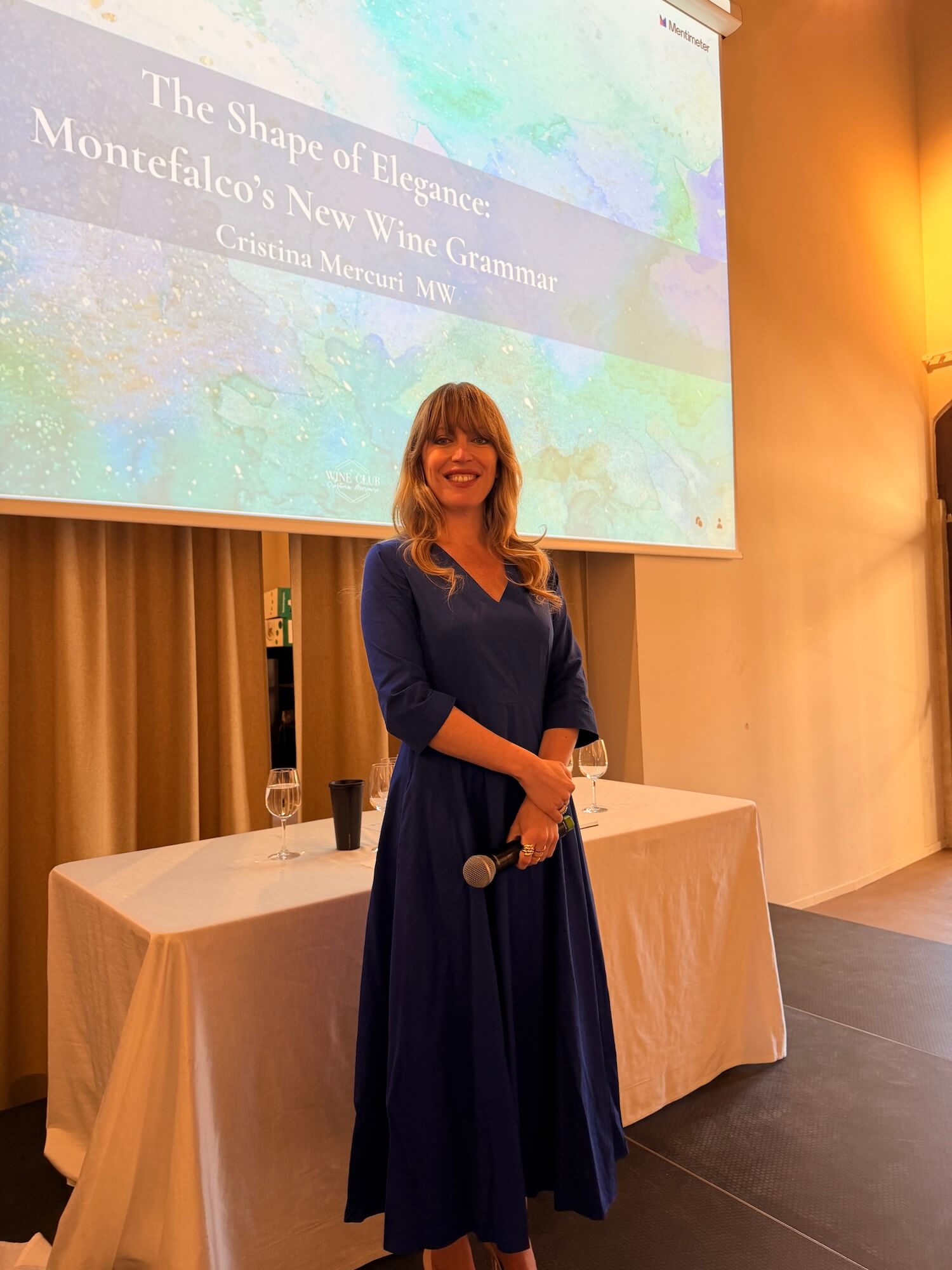
One of the very educational experiences during the Montefalco days was a Masterclass from Cristina Mecuri at the Chiostro S. Augustine in Montefalco.
Cristina Mercuri MW used her Montefalco masterclass to argue that this region is in the middle of a stylistic shift: from power to precision, from sheer opulence toward what she called “shaping elegance.” I attended her lecture and tutored tasting at the Chiostro di Sant’Agostino, and what follows is a condensed version of her presentation to help orient visitors to Montefalco’s wines in her words and through her comparisons.
From opulence to “shaping elegance”
Cristina began by placing Montefalco in a global context. Many now‑famous regions, she noted—Bordeaux, Napa Valley, Etna, the world of Super Tuscans—built their reputations on “opulent, generous, rich, abundant, bold” wines. Over time, however, the most interesting producers in those areas have shifted focus toward terroir: precision, definition, and a clearer link to soil and place. For her, Montefalco is at that same turning point today, especially with Trebbiano Spoletino, Montefalco Rosso and Montefalco Sagrantino.
Trebbiano Spoletino: texture and versatility
The first part of the tasting explored two expressions of Trebbiano Spoletino, the white grape that has become Montefalco’s stylistic counterpoint to Sagrantino. Spoletino, she stressed, is not about loud aromatics alone but about a particular kind of texture: wines that start linear and then expand across the palate.
Wine 1, a stainless‑steel Trebbiano Spoletino 2024, showed a “beautiful combination” of melon and stone fruit with green herbs and a touch of passion fruit, the latter linked to cool fermentation and protective handling. The nose was “fresh, pretty, uncomplicated and versatile,” but Cristina asked the room to focus on the feel rather than the fruit: the wine begins narrow, then fans out, creating what she likened to the sensation of applying lip balm on a winter day—an almost waxy, protective layer on the lips. The acidity, she emphasized, is high but broad and welcoming, not sharp or angular, which makes Spoletino’s signature texture “expansive but never heavy.”
Wine 2, also Trebbiano Spoletino 2024 but fermented in oak with spontaneous yeasts, offered a more subtle nose—white flowers, hints of stone fruit, a quieter aromatic profile overall. Again, the key was texture: the same linear‑then‑expanding Spoletino identity, now enriched by oak‑derived mid‑palate weight and layering. For Cristina, both versions “enhance the identity of the grape and the terroir,” with style—direct fruit versus discreet complexity—being a matter of personal preference rather than quality.
To frame Spoletino, she compared it to a white from Etna, a region that has already traveled from rustic, abundant wines toward more chiselled, terroir‑driven styles. The Etna Bianco, with Caricante at its core, showed clear oak but also “shaped elegance,” where the wood adds dimension without smothering the volcanic identity. The parallel, in her view, is that Montefalco’s Spoletino can follow a similar path: multiple stylistic options, but a core of texture and balanced acidity that must remain recognizable.
Montefalco Rosso: shades of red
The second flight moved to Montefalco Rosso, the DOC blend of Sangiovese with a portion of Sagrantino and often Merlot. Cristina used two 2020‑s‑era wines to illustrate how much stylistic variation can exist within one appellation.
The first Montefalco Rosso (from Tenuta Alzatura) combined roughly 60% Sangiovese, a “touch of Merlot,” and Sagrantino, with six months in oak and alcohol just above 14%. On the nose she highlighted its very floral, linear character—red fruit, rose petals, and a clear, plummy note from Merlot. On the palate, she invited us to “feel the tannins”: a juicier, more slender structure with granular, rounded tannins from Merlot, silkier ones from Sangiovese, and a final grip from Sagrantino that appears at the back of the palate. This combination, she argued, makes for a fresh, versatile wine, “modern in a light style” without sacrificing complexity.
The second Montefalco Rosso, from a different producer, was the “more serious” sibling. Same basic blend, but with different élevage and a slightly higher alcohol, it showed darker fruit—black cherry, blackberry—more evident oak toast and a fuller body. Here the tannins were “more on the gums,” broader and more structuring, giving what she called a “gastronomic” style: still clean and precise, but built for the table, perhaps for richer dishes.
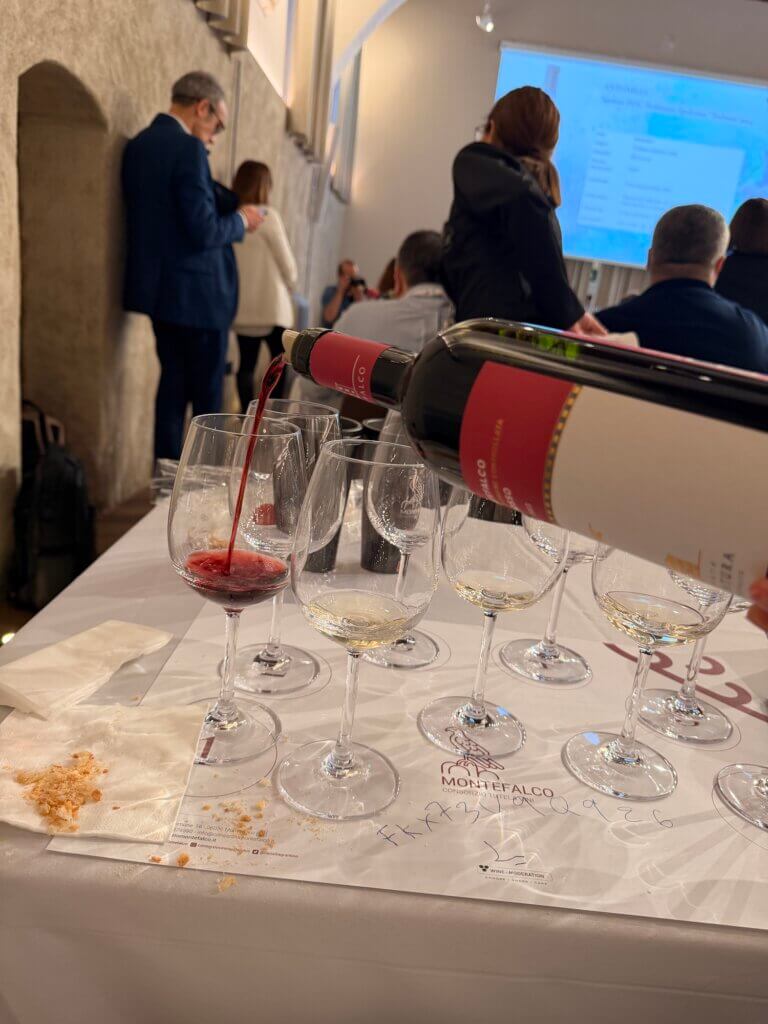
Across the room, preferences split almost 50/50 between the lighter, more floral first wine and the denser, darker second. Cristina underlined that this was the point: “Each wine has its consumer.” Within Montefalco Rosso, she said, there are “beautiful shades of style, from slender and modern to layered and food‑driven,” all valid as long as quality and terroir expression remain high.
She then brought in a comparison wine from a young Tuscan denomination (Terricciola / Costa Toscana style), based largely on Sangiovese with a touch of Cabernet. Here, spontaneous fermentation and extended aging in large oak aimed for artisanal precision. The point of this detour, she explained, was to show how even in emerging areas, the work of “building an identity” is ongoing, whereas Montefalco Rosso already shows a coherent direction: approachable wines with clear personality and high quality.
Montefalco Sagrantino: power refined
The final act belonged to Montefalco Sagrantino DOCG, the region’s flagship red and one of Italy’s most tannic wines. Cristina described Sagrantino with three words in other public remarks—“astonishing, accurate, aspirational”—and her flight here was designed to show why.
The first Sagrantino, a 2021 from the northern part of the area (Carapace), underwent a complex vinification in steel, oak and amphora, followed by two years in wood and further bottle aging. Despite 15.5% alcohol, the nose was “very nice,” with typical ripe black cherry and blackberry, plus balsamic Mediterranean herbs. On the palate, she drew attention to the tannin texture: assertive at first, gripping the sides of the tongue, then softening into a more velvety feel as acidity kicked in and made the mouth water. The finish, she noted with approval, was fruit‑forward rather than dry, bitter or dominated by toast.
The second Sagrantino, another 2021 from a different zone, had slightly lower but still significant alcohol and 24 months in small oak. Here the nose leaned more into dark ripe fruit and smokier oak, with a touch more austerity. On the palate, the tannins were “more difficult at the finish”—not in a negative sense, but more demanding and gastronomic, with a firmer, darker profile. Again, the room split on preference, and again Cristina insisted that both wines were high quality; what differed was their stylistic message.
To close the circle, she poured a classic Bordeaux, a Saint‑Estèphe dominated by Cabernet Sauvignon with Merlot and Cabernet Franc. Here, the angular, gum‑gripping tannins and defined black‑fruit profile served as a foil: proof that “elegance” does not mean lack of structure, and that Sagrantino, handled thoughtfully, can stand as an alternative to Cabernet in the global hierarchy of structured reds. In her words, Montefalco Sagrantino can now “communicate itself as a good alternative to Cabernet Sauvignon in an elegant way,” provided producers continue to manage tannin and alcohol without losing identity.
Throughout the lecture, Cristina returned to her central idea: Montefalco has moved beyond simple power. In Trebbiano Spoletino, Montefalco Rosso and Sagrantino, she sees wines that are “approachable yet very high in quality,” increasingly rooted in terroir, and capable of speaking not just to local tradition but to an international audience searching for precisely this combination of character and refinement.